
Does Insurance Cover Breast Reduction in Texas? A 2026 Clinical Guide to Approval
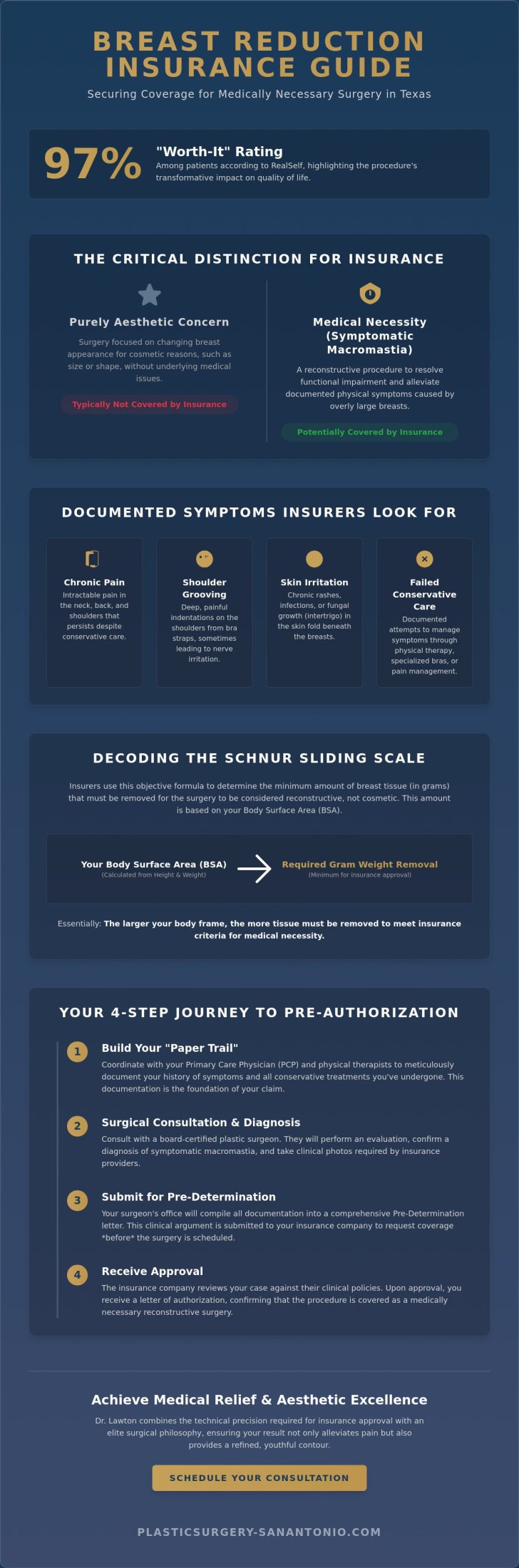
According to RealSelf, breast reduction surgery maintains a 97% worth-it rating among patients, yet the path to securing coverage remains one of the most rigorous clinical hurdles in modern reconstructive medicine. You’ve likely spent years managing the heavy physical burden of macromastia through physical therapy and specialized garments only to find that the chronic pain in your neck and shoulders persists. It’s exhausting to manage both the physical weight and the bureaucratic uncertainty of wondering, does insurance cover breast reduction in Texas, especially when conservative measures fail to provide the relief you deserve.
This guide provides a meticulous roadmap to the 2026 clinical standards, detailing exactly how to document your history to meet the stringent criteria set by major Texas providers. We’ll examine the precise metrics of the Schnur Sliding Scale and the 22nd percentile threshold required for a determination of medical necessity. You’ll learn how to navigate the pre-authorization process with the calm confidence of a patient who’s fully prepared for this transformative journey. By understanding these objective requirements and recent shifts in regional health legislation, you can move toward a life of physical lightness and surgical excellence with a board-certified plastic surgeon in San Antonio.
Key Takeaways
- Distinguish between purely aesthetic concerns and symptomatic macromastia to correctly position your surgery as a medically necessary reconstructive procedure.
- Navigate the rigorous documentation process for conservative treatments and physical symptoms to determine if and how does insurance cover breast reduction in Texas under your specific policy.
- Decode the complexities of the Schnur Sliding Scale to understand how your unique body surface area dictates the minimum gram-weight removal required for clinical approval.
- Establish a comprehensive “paper trail” by coordinating with primary care providers and physical therapists to streamline your pre-determination journey before surgery.
- Learn how advanced surgical philosophies allow for the achievement of medically mandated tissue removal while maintaining the refined, youthful contours of an elite aesthetic outcome.
Understanding Medical Necessity for Breast Reduction in Texas
“The key to unlocking your benefits lies in proving that the surgery is not for ‘beautification’ but for the restoration of normal function.”
Breast reduction surgery, or reduction mammoplasty, is a sophisticated procedure that often sits at the intersection of reconstructive necessity and aesthetic refinement. In the clinical landscape of San Antonio, Dr. Gary Lawton, MD, FACS, approaches this surgery as a vital intervention for those suffering from the physical weight of excessively large breasts. While many perceive this journey as purely elective, the Texas Department of Insurance and major regional payers recognize it as a reconstructive necessity when it’s performed to resolve functional impairment. Determining does insurance cover breast reduction in Texas starts with shifting the focus from how the breasts look to how they affect your physiological well-being.
Symptomatic macromastia is the clinical term for breasts that are so large they cause secondary health issues. This condition is distinct from purely aesthetic concerns because it results in a documented trail of physical distress. Patients often present with chronic, intractable pain in the neck, back, and shoulders, along with deep grooving from bra straps that can lead to permanent nerve irritation. When these symptoms are present, the procedure moves out of the category of cosmetic enhancement and into the realm of medically necessary reconstruction.
Macromastia vs. Hypertrophy: The Clinical Distinction
Diagnosis begins with identifying the specific anatomical criteria of your condition. While hypertrophy refers to general breast enlargement, macromastia specifically denotes a volume that’s disproportionate to your frame and causes physical ailments. These conditions often stem from significant hormonal fluctuations during puberty or pregnancy, which can lead to rapid and painful tissue growth. Dr. Lawton performs a meticulous evaluation to confirm these clinical markers, as a formal diagnosis of macromastia is the essential foundation for any insurance claim. Without this specific clinical distinction, insurers may default to viewing the procedure as a cosmetic breast lift.
The Role of Texas Insurance Mandates in 2026
By 2026, major Texas providers such as Blue Cross Blue Shield of Texas, UnitedHealthcare, and Aetna have established rigorous protocols for approving reconstructive claims. The key to unlocking your benefits lies in proving that the surgery is not for “beautification” but for the restoration of normal function. This proof is traditionally presented through a Pre-Determination letter. This document is a comprehensive clinical argument that details your symptoms, the failure of conservative treatments, and the surgeon’s technical plan. Understanding how does insurance cover breast reduction in Texas requires recognizing that the burden of proof rests on demonstrating that your quality of life is significantly hindered by your physical proportions.
The Texas Insurance Checklist: Requirements for Approval
Securing a determination for reconstructive surgery in the Lone Star State requires more than a simple clinical diagnosis. Texas-based providers, including Blue Cross Blue Shield of Texas and UnitedHealthcare TX, adhere to a rigorous set of criteria designed to differentiate between elective enhancement and functional restoration. When patients ask, “does insurance cover breast reduction in Texas,” they must understand that approval is contingent upon a meticulously documented history of physical distress that hasn’t responded to non-surgical interventions. This clinical checklist serves as the foundation of your case, providing the objective evidence required by insurance adjusters to authorize the procedure.
One of the most critical elements in this process is the documentation of intertrigo, which refers to chronic skin rashes, infections, or fungal growth beneath the breast fold. Insurance providers view persistent intertrigo as a clear indicator that the weight and position of the breast tissue are causing dermatological harm. Additionally, most Texas plans mandate the consistent use of a professionally fitted, wide-strapped support bra for a specified period. This requirement aims to prove that even with maximum external support, the physical burden remains unmanageable. Payers also closely monitor Body Mass Index (BMI); while a high BMI doesn’t always result in an automatic denial, some insurers may require a period of weight stability to ensure that the breast volume is not simply a reflection of overall body mass.
Documenting Failed Conservative Measures
In accordance with American Society of Plastic Surgeons guidelines, most insurance companies require a three to six month window of documented conservative treatment. This isn’t merely a suggestion but a mandatory prerequisite for approval. Your clinical record should include detailed notes from a primary care physician, physical therapist, or chiropractor. These records must verify that you’ve attempted to alleviate pain through targeted exercises, posture correction, or the use of anti-inflammatory medications without achieving significant relief. If you’re currently managing these symptoms, you can consult with a specialist to begin organizing your clinical timeline.
Physical Findings and Diagnostic Imaging
The physical evaluation focuses on unmistakable markers of symptomatic macromastia, most notably “shoulder grooving.” These deep indentations caused by bra straps provide visual proof of the heavy downward tension exerted on the musculoskeletal system. Diagnostic imaging also plays a vital role; for patients over the age of 40, or those with a significant family history, a recent mammogram is typically required to ensure breast health before proceeding with surgery. Finally, high-quality clinical photography remains the most persuasive tool for the insurance adjuster. These images don’t focus on aesthetics but rather on the objective proportions and the secondary skin conditions that justify the surgery as a medical necessity. Understanding how does insurance cover breast reduction in Texas means recognizing that these photographs are a standard part of the medical record, handled with the utmost privacy and professional ethics.
The Schnur Scale: Calculating Gram-Weight Requirements
“If the final pathology report shows the surgeon removed even slightly less than the pre-authorized weight, the insurance company may issue a retroactive denial — this risk highlights why meticulous preoperative planning is essential.”
While documenting physical symptoms is a vital first step, the ultimate clinical determination often rests on a precise mathematical formula known as the Schnur Sliding Scale. This instrument serves as the industry gold standard for Texas insurance adjusters when they evaluate medical necessity. When patients ask, “does insurance cover breast reduction in Texas,” they’re often surprised to learn that approval isn’t just based on pain levels; it’s based on the ratio of breast tissue removed to your total Body Surface Area (BSA). This calculation ensures that the volume of tissue being excised is significant enough to provide a true functional benefit rather than a purely aesthetic change.
The “500-gram rule” was once a common benchmark, but modern clinical policies have shifted toward the more individualized Schnur Scale. This shift means that a taller or larger-framed patient may be required to have 700 or 800 grams removed per breast to qualify, while a more petite individual might meet the threshold with 350 grams. It’s a rigid standard; if the final pathology report shows that the surgeon removed even slightly less than the pre-authorized weight, the insurance company may issue a retroactive denial. This risk highlights why choosing a surgeon with meticulous preoperative planning is essential for protecting your financial interests.
Reconstructive vs. Cosmetic: The Weight Threshold
To qualify as a reconstructive procedure, the amount of tissue removed must typically fall at or above the 22nd percentile of the Schnur Scale. This requirement often creates a complex clinical dialogue during the consultation. Some patients worry that removing the amount of tissue required by insurance will leave them smaller than they desire; conversely, others may find that the insurance-mandated minimum is exactly what they need for relief. Aetna’s clinical policy on breast reduction provides a transparent look at these gram-weight tables, showing how your height and weight directly dictate the surgical plan. Balancing these medical mandates with your personal aesthetic goals requires a surgeon who views the procedure as both a clinical necessity and a refined artistic journey.
Navigating the BMI Objection
Many Texas insurers utilize Body Mass Index (BMI) as a surrogate for both surgical risk and medical necessity. If a patient’s BMI is significantly elevated, insurers may argue that the breast size is a result of generalized adipose tissue rather than glandular hypertrophy. In these cases, they might require a period of weight stability or even weight loss before granting approval. The clinical rationale is rooted in safety and the longevity of the results. Achieving a stable weight ensures that the breast reduction addresses the underlying macromastia without the risk of future sagging or volume changes that can occur with significant weight fluctuations after the procedure. It’s about ensuring your transformation is both safe and permanent.
The Pre-Determination Journey: A Step-by-Step Guide
The administrative path to approval is as precise as the surgery itself, requiring a coordinated effort between your surgical team and your primary care network. While the mathematical thresholds discussed previously provide the framework, the actual submission process determines how does insurance cover breast reduction in Texas for your specific case. This journey is structured into five distinct clinical and administrative milestones designed to secure a formal Letter of Approval, ensuring that your path to relief is handled with the highest level of professional care.
Comprehensive consultation with a board-certified plastic surgeon to establish a clinical diagnosis of macromastia.
Compile a detailed “paper trail” of records from PT, chiropractors, or PCPs documenting 3–6 months of failed conservative therapy.
Clinical coordinators submit a Pre-Determination request with medical history, photos, and calculated Schnur tissue weight.
Insurance medical director reviews the file; a “Peer-to-Peer” consultation may occur between the surgeon and the insurer’s medical officer.
Once the formal Letter of Approval is received, move forward knowing your procedure is recognized as medically necessary.
Coordinating with Your San Antonio Medical Team
Lawton Plastic Surgery maintains close professional relationships with primary care providers throughout Alamo Heights and Boerne to ensure a seamless exchange of medical records. It’s essential that your medical records utilize specific clinical terminology that aligns with insurance requirements, such as “functional impairment” and “refractory pain.” We recommend initiating this process approximately six months before your desired surgery date. This lead time allows for the collection of high-quality data and accounts for the typical 30 to 45 day review period required by most Texas payers.
What to Do if Your Claim is Denied
An initial denial isn’t necessarily the end of your journey, but it does require a strategic clinical response. It’s vital to distinguish between a denial based on “lack of medical necessity,” which can often be appealed with more data, and a “contractual exclusion,” which means the policy simply doesn’t cover the procedure regardless of the severity of symptoms. If you encounter a medical necessity denial, our dedicated patient advocates work to submit additional clinical evidence or clarify the specific surgical plan. To begin this meticulously managed process and evaluate your eligibility, schedule your clinical consultation to review your history and insurance benefits.
Take the first step in your meticulously managed approval journey with a clinical consultation.
Why Elite Surgical Precision Matters for Medical Reductions
While the administrative process focuses heavily on the question, does insurance cover breast reduction in Texas, the surgical phase requires a different level of scrutiny. Achieving the specific gram-weight removal mandated by your insurance provider should never result in a compromised aesthetic outcome. Dr. Gary Lawton, MD, FACS, approaches each procedure with the philosophy that clinical necessity and artistic refinement are not mutually exclusive. By utilizing advanced surgical methodologies, he ensures that the physical burden of macromastia is lifted while simultaneously restoring a youthful, balanced contour that complements your unique proportions.
The technical challenge of a medical reduction lies in the precise excision of tissue to meet the Schnur Scale requirements without sacrificing the blood supply to the nipple-areola complex. Dr. Lawton’s elite training and decades of experience allow him to navigate these complexities with calm confidence. This meticulous approach transforms a standard medical procedure into a holistic, high-end journey, where the primary goal is your personal transformation and long-term physical relief. For the high-achieving professionals of San Antonio, this means receiving care that is grounded in medical ethics and surgical sophistication.
The Inverted-T and Vertical Techniques
Gold standard for extensive reductions. Allows the greatest degree of tissue excision and reshaping, particularly effective for meeting high gram-weight thresholds.
An option for patients whose insurance-mandated removal is more moderate. Minimizes scarring while still achieving a lifted, stable result.
The choice of surgical technique is often dictated by the volume of tissue that must be removed to satisfy insurance criteria. The Inverted-T, or anchor technique, remains the gold standard for extensive reductions because it allows for the greatest degree of tissue excision and reshaping. This method is particularly effective for meeting the high gram-weight thresholds required for a determination of medical necessity. For patients whose insurance-mandated removal is more moderate, the vertical or “lollipop” technique may be an option to minimize scarring. Regardless of the approach, Dr. Lawton prioritizes technical finesse to ensure that incisions are placed discreetly and that the final breast shape is lifted and stable.
Your Consultation at Lawton Plastic Surgery
Your private evaluation in our San Antonio facility is a comprehensive clinical review designed to align your physical goals with the requirements of your insurance policy. We understand that the path to approval can be filled with anxiety, which is why our team provides a reassuring, patient-centered environment from your first visit. We assist you in the insurance verification process by providing the precise clinical documentation and photographic evidence your provider requires. This individualized care ensures that every step of your journey is handled with the transparency and professional weight you expect from a top-tier practice.
To begin your transformation and find relief from the weight of macromastia, schedule your clinical evaluation with Dr. Lawton today.
Reclaiming Your Physical Freedom and Confidence
Securing approval for reduction mammoplasty involves a rigorous adherence to the Schnur Sliding Scale and a well-documented history of failed conservative treatments. By prioritizing clinical documentation and understanding the 2026 insurance landscape, you transition from managing chronic pain to achieving lasting physical relief. Many patients find that the answer to the question, does insurance cover breast reduction in Texas, is a definitive yes when their case is presented with surgical and administrative precision. This journey is not merely a clinical transaction but a path toward a lighter, more active lifestyle.
Dr. Gary Lawton, MD, FACS, has been serving San Antonio and the Hill Country since 1999, bringing elite clinical expertise to every reconstructive journey. As a surgeon Board-Certified by the American Board of Plastic Surgery with top-tier statistical rankings in patient satisfaction, he meticulously bridges the gap between medical necessity and aesthetic excellence. You don’t have to carry the physical and emotional burden of macromastia alone; expert guidance and a clear roadmap to approval are within your reach. Your transformation into a life of comfort and confidence starts with a single, informed step.
Frequently Asked Questions
How many grams of tissue must be removed for insurance to cover breast reduction in Texas?
The specific weight requirement is determined by your Body Surface Area (BSA) using the Schnur Sliding Scale. Most Texas policies require the amount of tissue removed to fall at or above the 22nd percentile for your body size. For many patients, this equates to a minimum of 350 grams per breast, though larger individuals may be required to have significantly more removed to meet clinical necessity standards.
Does Blue Cross Blue Shield of Texas cover breast reduction for back pain?
Blue Cross Blue Shield of Texas provides coverage for reduction mammoplasty when it’s performed to alleviate chronic back, neck, or shoulder pain. To secure approval, you must provide a documented history of symptomatic macromastia and proof that conservative treatments didn’t provide relief. The procedure is covered when it’s classified as a reconstructive necessity rather than an elective cosmetic enhancement.
Can I get a breast reduction if my BMI is over 30?
You can undergo a breast reduction with a BMI over 30, but some insurers may require a period of weight stability before authorizing the procedure. Providers often review BMI to determine if the breast volume is glandular hypertrophy or related to generalized adipose tissue. While a higher BMI isn’t an automatic disqualification, it requires a meticulous clinical argument to prove the surgery is medically necessary.
How long does the insurance approval process take in San Antonio?
The formal insurance review period in San Antonio typically spans 30 to 45 days once the pre-determination request is submitted. However, the total timeline is longer because you must first complete three to six months of documented conservative therapy. When evaluating does insurance cover breast reduction in Texas, it’s wise to begin your clinical consultations early to ensure all necessary evidence is gathered for your file.
What is the “Schnur Scale” and how does it affect my surgery?
The Schnur Scale is a mathematical formula that relates your total Body Surface Area to a minimum weight of breast tissue that must be removed. It acts as the primary tool for Texas insurance adjusters to differentiate between elective and reconstructive surgery. If your surgeon removes less than the scale mandates, the insurance company may deny the claim; this calculation directly dictates the technical plan for your surgery.
Will insurance cover a breast lift at the same time as a reduction?
Insurance coverage for a breast reduction naturally includes the lifting and repositioning of the nipple-areola complex to a more functional position. While a standalone breast lift is considered cosmetic and isn’t covered, the reconstructive nature of a reduction mammoplasty achieves a similar aesthetic elevation. The primary goal of the procedure must remain the removal of the specific gram-weight required by your insurance policy.
What evidence do I need from my physical therapist for insurance approval?
Your physical therapist must provide clinical notes documenting the duration of your treatment and the specific exercises used to address your pain. These records should explicitly state that despite consistent effort, your symptoms remained refractory to non-surgical intervention. This evidence is vital when determining does insurance cover breast reduction in Texas, as it proves that conservative measures were insufficient for your condition.
Is breast reduction considered cosmetic or reconstructive by most Texas insurers?
Breast reduction is classified as reconstructive surgery by most Texas insurers when it’s performed to resolve functional impairment and documented physical distress. If the procedure is sought purely for aesthetic changes without an accompanying history of pain or skin conditions, it’s considered cosmetic. The key to reconstructive classification lies in proving medical necessity through clinical measurements, photographic evidence, and a history of failed conservative treatments.
Disclaimer
Medical & Educational Disclaimer
All content presented on this website, including blog articles, written materials, images, videos, and any associated media, is provided strictly for informational and educational purposes. This content is not intended to serve as medical advice, diagnosis, or treatment, and should not be interpreted as a substitute for consultation with a qualified, licensed healthcare professional.
No doctor–patient relationship is established by your use of this website, engagement with its content, or communication through any digital platform, including contact forms, email, or social media. Medical care is highly individualized, and the information presented here may not apply to your specific condition, anatomy, or circumstances. You should always seek the guidance of a qualified physician regarding any medical concerns, treatments, or decisions.
While every effort is made to ensure accuracy and relevance, medical knowledge evolves rapidly, and no guarantee is made regarding the completeness, reliability, or current applicability of the information provided. The practice and its representatives expressly disclaim any liability for errors, omissions, or outcomes related to the use or misuse of this content.
Surgical & Aesthetic Outcomes Disclaimer
All surgical and non-surgical procedures carry inherent risks. Outcomes vary based on individual factors including anatomy, healing capacity, adherence to post-operative protocols, and overall health status. Any descriptions, discussions, or examples of outcomes presented on this website are illustrative only and should not be interpreted as guarantees of specific results. Before-and-after images, if presented, represent individual cases and do not reflect typical results.
Wellness, Nutrition & Supplementation Disclaimer
Content related to nutrition, supplementation, longevity, metabolic optimization, and integrative or holistic health strategies is provided for educational purposes only. These discussions may include emerging science, theoretical frameworks, or practitioner-based protocols that are not universally accepted within conventional medical standards. Supplements and wellness interventions may interact with medications or underlying health conditions. Consultation with a qualified healthcare provider is strongly recommended prior to initiating any new regimen.
Affiliate & Financial Disclosure
This website may contain links to third-party products, services, or platforms. Some of these links may be affiliate links, meaning a commission may be earned if a purchase is made through them. This comes at no additional cost to you. Product recommendations are based on professional judgment, clinical experience, and research; however, no guarantees are made regarding performance, efficacy, or outcomes. The practice assumes no responsibility for third-party products, services, or claims.
External Links Disclaimer
This website may reference or link to external websites for informational purposes. These sites are not controlled or operated by this practice, and no responsibility is assumed for the accuracy, content, privacy practices, or policies of any third-party website.
Limitation of Liability
By using this website, you acknowledge and agree that you assume full responsibility for any actions taken based on the information provided. Under no circumstances shall the practice, its physicians, affiliates, or representatives be liable for any direct, indirect, incidental, or consequential damages arising from the use of this content.
Consent
By accessing and using this website, you acknowledge that you have read, understood, and agree to this disclaimer in its entirety.