
When Can I Drive After Breast Augmentation? A Clinical Guide to Safe Recovery
The ability to operate a vehicle safely after surgery is not merely a matter of personal comfort; it’s a critical clinical milestone defined by the restoration of pectoral reflex speed and upper-body range of motion. For many patients pursuing aesthetic refinement, the question of when can I drive after breast augmentation represents a vital step toward reclaiming their personal independence and daily rhythm. While the desire to return to a standard routine is understandable, the physical demands of defensive driving require a level of muscular responsiveness that must be meticulously evaluated to protect both your safety and your surgical results.
You’ve likely encountered conflicting timelines online that leave you feeling uncertain about the safest path forward during your recovery journey. We understand that the temporary loss of mobility can be frustrating, especially when you’re eager to enjoy your new profile. This guide provides a definitive, medically-backed roadmap for transitioning back to the driver’s seat by detailing the specific physiological requirements and safety benchmarks our elite surgical team monitors. You’ll discover a practical checklist to determine your readiness, an explanation of the risks associated with premature activity, and the precise timeline for discontinuing medications before it’s safe to take the wheel.
Key Takeaways
- Understand why the first 48 to 72 hours require absolute rest as your body clears residual anesthesia and regains the cognitive precision necessary for safe vehicle operation.
- Learn how the biomechanics of steering and emergency braking engage the pectoral muscles, and why rushing back to the wheel could risk implant displacement.
- Discover the stationary “dry run” protocol used to assess your clinical readiness and answer the pivotal question of when can I drive after breast augmentation.
- Evaluate the specific environmental risks of navigating high-traffic corridors like I-10 and Loop 1604 during the early stages of your surgical recovery.
- Gain insight into Dr. Gary Lawton’s meticulous recovery philosophy that prioritizes individualized clinical milestones over generic, one-size-fits-all timelines.
The Immediate Post-Operative Window: Why 48-72 Hours is Non-Negotiable
“Safety isn’t just about how you feel; it’s about the chemical reality of your bloodstream and your ability to maintain control in an emergency.”
The transition from the surgical suite to your home environment is a phase that demands meticulous attention and professional oversight. For the first 48 to 72 hours, having a dedicated caregiver is essential because they manage your initial mobility and ensure your safety as the body begins its healing journey. Determining when can I drive after breast augmentation begins with a strict adherence to this observation period, as the body is not yet physically or neurologically prepared for the complexities of road safety. This timeframe isn’t just about comfort; it’s about clinical stability and protecting your aesthetic investment.
During these first 48 hours, the focus remains on minimizing initial edema and allowing the newly placed implants to settle into their anatomical pockets. While reviewing a Breast Augmentation Overview provides a foundation for understanding the surgical process, your immediate recovery is dictated by metabolic clearance and tissue response. Sudden movements or the physical strain of steering can disrupt delicate internal healing, potentially leading to increased swelling or minor implant displacement. Restricting your activity during this window ensures that the initial inflammatory response is managed effectively.
To better understand the clinical requirements for returning to the road, watch this helpful guide on post-operative safety:
“Brain fog” can linger up to 72 hours, slowing neurological processing and motor reflexes below baseline.
Clearance window: 24–48 hours minimum for sedative metabolic clearance.
Opioids significantly impair depth perception and reaction speeds — an absolute legal and safety barrier.
Required gap: 12–24 hours fully off narcotics before driving.
Anesthesia and Cognitive Lag
The phenomenon often described as “brain fog” is a documented physiological response to general anesthesia that can linger for up to 72 hours. Even if you feel alert within the first 24 hours, your neurological processing speeds and motor reflexes are often significantly slower than your baseline. This discrepancy between perceived readiness and clinical capability is why driving yourself home or operating a vehicle shortly after surgery is strictly prohibited. The half-life of common surgical sedatives typically dictates a 24 to 48-hour window where motor coordination and decision-making remain clinically compromised regardless of the patient’s perceived alertness.
The Narcotic Medication Barrier
The use of prescription narcotics for pain management creates an absolute legal and safety barrier to driving. Opioids significantly impair depth perception and reaction speeds, making it impossible to respond effectively to sudden traffic changes or emergency braking. Most patients can transition from prescription medications to over-the-counter alternatives within five to seven days. You must be completely off all narcotic pain relief for at least 12 to 24 hours before even considering a return to the driver’s seat. Safety isn’t just about how you feel; it’s about the chemical reality of your bloodstream and your ability to maintain control in an emergency. Consulting with your surgical team remains the only way to verify when can I drive after breast augmentation based on your specific medication taper and recovery progress.
Beyond Pain Meds: The Physical Demands of Driving After Breast Surgery
Returning to the driver’s seat involves more than simply clearing the pharmacological effects of anesthesia. While many patients focus on the cessation of narcotics, the physical mechanics of operating a vehicle place specific, strenuous demands on the chest wall and pectoral muscles. Understanding when can I drive after breast augmentation requires an appreciation for how steering, shifting, and even stabilizing your body against centrifugal force can impact your internal healing environment. Driving is an active, physical task that necessitates full upper-body mobility and the ability to react with strength in an instant.
The surgical technique employed during your procedure significantly influences your physical readiness. For instance, submuscular placement involves the elevation of the pectoralis major muscle to create a pocket for the implant. This method typically necessitates a more conservative approach than subglandular placement, as any forceful contraction of the chest muscles during steering can lead to discomfort or, in rare cases, implant displacement. Most patients find that they need at least 10 to 14 days for the muscle fibers to settle before they can comfortably manage the torque required for sharp turns or defensive maneuvers.
Pectoral Muscle Engagement and Healing
Steering a vehicle is not a passive activity. Every rotation of the wheel engages the pectoral complex, which is precisely the area undergoing significant remodeling. While gentle daily movements are encouraged to maintain circulation, the emergency maneuvers required in traffic, such as a sudden swerve to avoid an obstacle, demand a level of muscular force that can cause a hematoma or seroma if performed too early. These complications occur when a blood vessel or lymphatic channel reopens due to physical strain, potentially compromising your aesthetic results. Safety on the road requires the clinical restoration of your pectoral reflex speed, ensuring you can react without hesitation or sharp, restrictive pain.
The Seatbelt Dilemma
Proper seatbelt usage is non-negotiable for road safety, yet the diagonal strap often crosses directly over the surgical site. To manage this, many patients utilize a seatbelt pillow or a soft, folded towel to distribute the pressure across the chest without compressing the incisions or the surgical bra. You should never place the shoulder belt behind your back; instead, focus on adjusting the seat height or using a buffer to ensure the strap rests securely but comfortably. As noted by the FDA on Driving and Medication, any physical discomfort that distracts you from the road can be just as dangerous as chemical impairment. If the pressure of the belt causes you to flinch or alter your posture, it’s a clear indicator that your body needs more time to heal before you resume regular commutes.
For those seeking a highly individualized recovery plan that prioritizes both safety and superior aesthetic outcomes, scheduling a consultation at Gary Lawton, MD, FACS can help clarify your specific milestones based on your unique anatomy and surgical technique.
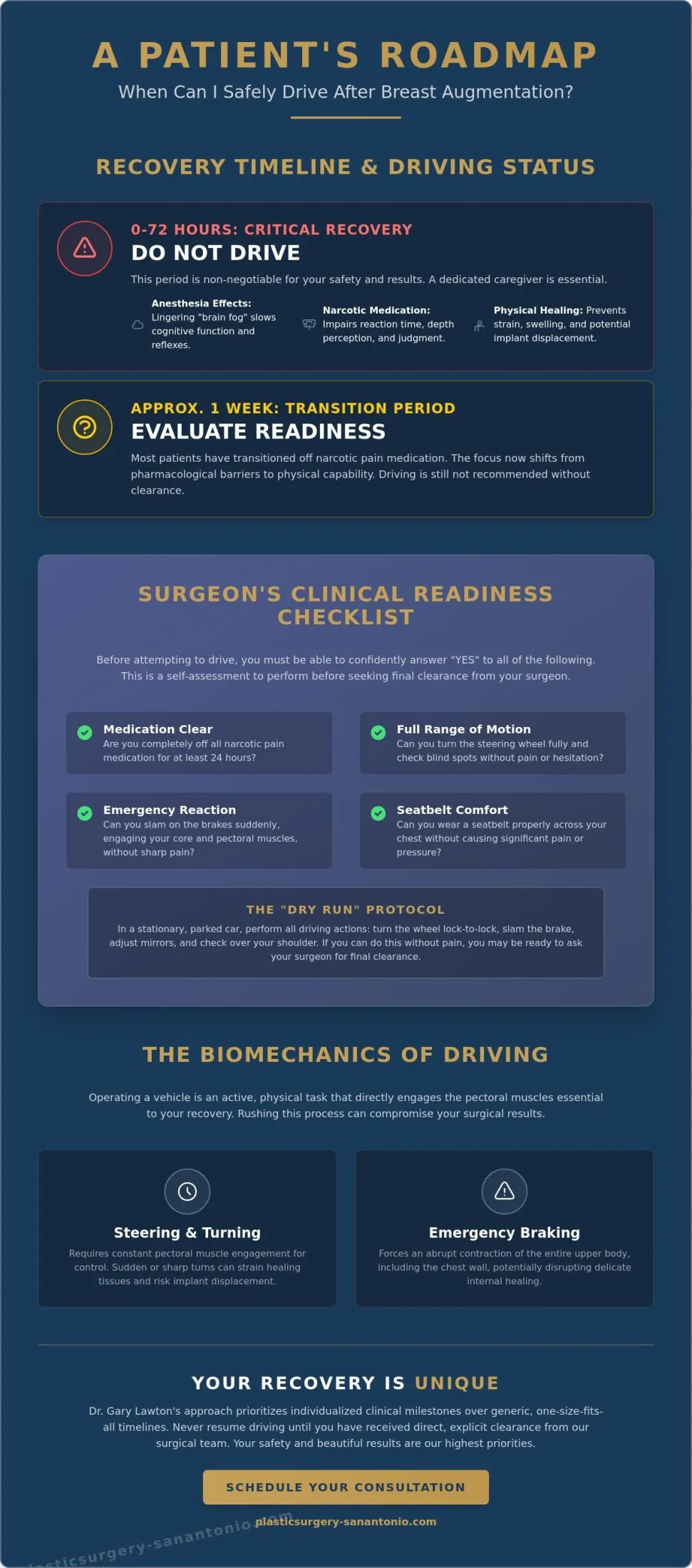
A Surgeon’s Checklist: Are You Clinically Ready to Drive?
“The ‘Dry Run’ is the most effective method for evaluating your current status — before attempting to navigate traffic, spend time in a stationary vehicle to simulate the movements required for safe operation.”
Determining your readiness to return to the road is an objective process that requires a meticulous evaluation of your physical and cognitive capabilities. While general timelines offer a helpful baseline, your individual healing rate and the specific surgical techniques utilized by your surgeon dictate the final clearance. Following the ASPS Recovery Guidelines ensures you are meeting industry-standard safety benchmarks before assuming the responsibility of a vehicle. A structured self-assessment allows you to verify that your body can handle the rigors of defensive driving without compromising your surgical outcomes.
The “Dry Run” is the most effective method for evaluating your current status. Before attempting to navigate traffic, spend time in a stationary vehicle to simulate the movements required for safe operation. This controlled environment allows you to test your limits without the pressure of a moving environment. If you experience sharp pain, significant tightness, or a restrictive pulling sensation in the chest wall, your body is signaling that more recovery time is necessary. During your follow-up appointment, Gary Lawton, MD, FACS, will provide a final clinical review to confirm your readiness based on your incision healing and implant settling.
Rotate steering wheel fully left and right; check blind spots by rotating torso and neck; reach gear shift and emergency brake.
Pass criteria: No sharp discomfort, hesitation, or strain.
Sit in driver’s seat and quickly move right foot from accelerator to brake pedal.
Pass criteria: Swift and decisive without sympathetic pain in the chest.
The Range of Motion Test
Safe driving requires a full, pain-free range of motion in the upper body and torso. Sit in your parked car and attempt to rotate the steering wheel fully to the left and then to the right to ensure you can manage a sharp turn or emergency swerve. Next, verify your ability to check your blind spots by rotating your torso and neck; you should be able to perform these movements without sharp discomfort or hesitation. You must also confirm that you can reach the gear shift and emergency brake effortlessly from your standard driving position. If these reaching movements cause you to flinch or strain, you aren’t yet prepared for the physical demands of the road.
The Reaction Time Assessment
Mental clarity is just as vital as physical mobility when deciding when can I drive after breast augmentation. Evaluate your current state for any lingering dizziness, fatigue, or “brain fog” that could delay your response to a sudden hazard. Perform the “Stomp Test” by sitting in the driver’s seat and quickly moving your right foot from the accelerator to the brake pedal. This movement must be swift and decisive, occurring without any sympathetic pain in the chest area that might cause you to pull back. Once you pass these internal checks, your first drive should be a brief, five-minute trip to a familiar location during low-traffic hours. Monitor your body closely afterward for any increased swelling or localized pain, as these are signs that you may need to wait another few days before resuming regular driving duties.
Navigating San Antonio Traffic During Your Recovery
The geographic reality of South Texas presents unique challenges when determining when can I drive after breast augmentation, as our local infrastructure often requires extended periods behind the wheel. Unlike more compact urban centers, the San Antonio-New Braunfels corridor is characterized by high-speed transit and significant distances between residential areas and clinical facilities. This environment demands more than just basic motor skills; it requires the endurance to maintain a static posture while navigating complex interchanges. Understanding how local traffic patterns affect your healing process is a vital component of a sophisticated recovery plan.
Heavy congestion on major arteries such as I-10 or Loop 1604 necessitates frequent, abrupt braking, which places repetitive strain on the pectoral muscles and the surgical site. Each sudden stop forces the body forward against the seatbelt, potentially causing irritation to the incisions or increasing localized inflammation. Additionally, the intense San Antonio heat can exacerbate post-operative swelling if the vehicle cabin is not pre-cooled. Maintaining optimal hydration and a stable, cool environment during car trips is essential to prevent heat-induced edema from complicating your initial results.
Commute Times and Muscle Fatigue
Patients traveling from outlying communities like Boerne or Seguin must recognize that a 45-minute commute is qualitatively different than a brief trip around the block. Extended periods of arm elevation and steering wheel manipulation can lead to significant chest stiffness and muscle fatigue, which may not be apparent during a shorter test drive. We recommend breaking up longer drives with brief periods of rest to allow the pectoral complex to relax. Prioritizing climate control within your vehicle is not merely a matter of comfort; it’s a clinical necessity to manage inflammation and ensure your metabolic rate remains stable during transit.
Safe Routing for New Braunfels and Austin Patients
For those visiting from New Braunfels or Austin, selecting low-stress routes during the first week of driving reduces both the cognitive load and the physical demands on your body. Utilizing familiar roads and avoiding peak rush hour on the I-35 corridor can prevent the need for aggressive defensive maneuvers that might strain your healing tissues. Having a backup driver remains essential for the first 10 days post-surgery, providing you with the flexibility to relinquish control if you experience unexpected fatigue or discomfort. To ensure your travel plans align with your clinical milestones, you should consult with Gary Lawton, MD, FACS to coordinate your follow-up schedule during lower-traffic windows.
The Lawton Approach: Meticulous Care for Superior Results
Gary Lawton, MD, FACS, approaches each surgical procedure as a unique synthesis of rigorous medical science and refined aesthetic artistry. His philosophy centers on the belief that superior results are the direct product of technical precision and a deeply individualized recovery plan. By maintaining high-percentile statistical rankings for patient safety and satisfaction, he ensures that every patient’s transition back to their daily rhythm is handled with the highest level of professional weight. This commitment to clinical excellence directly influences the specific guidance provided regarding when can I drive after breast augmentation, as your timeline is never a generic estimate but a calculated medical milestone based on your body’s specific response to surgery.
Advanced surgical finesse, including the use of meticulous dissection and specialized suturing techniques, often leads to a more predictable and comfortable recovery for our patients. We view the medical service as a holistic, high-end journey rather than a mere transaction, which means your post-operative support is just as sophisticated as the surgery itself. This level of care reduces the likelihood of minor complications that could otherwise delay your return to the driver’s seat. Our goal is to provide a foundation of absolute trust, where you feel empowered by the knowledge that your safety and your results are being protected by industry-leading expertise.
Individualized Recovery Protocols
Dr. Lawton tailors each recovery protocol to the patient’s unique anatomy, body type, and specific implant choice. For patients receiving submuscular placement, he may utilize specialized internal support or meticulous suturing techniques to enhance pocket stability during the initial healing phase. These advanced methods provide a structural foundation that allows for a more confident return to physical activity. We recognize that a patient with a more active lifestyle or a longer commute may require different benchmarks than someone with a more sedentary routine. Achieving elite aesthetic outcomes requires a strict adherence to these professional guidelines, ensuring that your pectoral muscles are fully prepared for the physical stresses of defensive driving before you take the wheel.
Your Consultation at Lawton Plastic Surgery
We invite San Antonio residents to explore the possibilities of personal transformation within a private, sophisticated environment that prioritizes your privacy and comfort. During your consultation, the focus remains on achieving subtle, high-quality outcomes that align with your specific aesthetic goals and lifestyle requirements. We discuss your recovery objectives in detail to ensure your post-operative plan supports a rapid yet clinically safe return to your routine. By choosing a board-certified professional with a reputation for technical precision, you’re investing in a safer, more refined surgical experience.
Reclaiming Your Independence with Clinical Confidence
Transitioning back to your daily routine requires a meticulous balance between personal autonomy and surgical safety. You’ve learned that determining when can I drive after breast augmentation depends on the clearance of pharmacological sedatives and the restoration of pectoral muscle responsiveness. By utilizing our clinical checklist and accounting for the specific demands of San Antonio’s highway corridors, you ensure that your return to the road is both safe and sustainable.
Dr. Gary Lawton, who’s board-certified by the American Board of Plastic Surgery, leverages over 25 years of surgical excellence in San Antonio to guide you through this holistic, high-end journey. His commitment to high-end, natural-looking breast contouring is matched only by his dedication to your comprehensive post-operative support. Your path to a refined new profile is built on a foundation of absolute trust and expert guidance.
Frequently Asked Questions
Can I drive myself home after breast augmentation surgery?
No, you cannot drive yourself home following your procedure. The residual effects of general anesthesia and sedative medications significantly impair your motor skills, reaction times, and cognitive judgment for at least 24 to 48 hours. It’s essential to arrange for a responsible adult to provide transportation and monitor your initial stability in a home environment.
What happens if I have to slam on my brakes shortly after surgery?
Slamming on your brakes forces a sudden, intense contraction of the pectoralis major and minor muscles as you brace for impact. This forceful engagement can potentially cause implant displacement or the reopening of blood vessels, leading to a hematoma. Such emergency maneuvers place extreme stress on healing tissues, which is why clinical readiness must be verified before you return to the road.
Is it okay to drive if I only had a local anesthetic?
Even if your procedure utilizes only local anesthesia, driving immediately is not recommended. The physical trauma of surgery and the potential for a vasovagal response or sudden discomfort can compromise your reaction times behind the wheel. Most clinical protocols require a minimum 24-hour observation period to ensure you’re neurologically stable and physically capable of safe operation.
How long should I wait to drive if I had a Mommy Makeover?
Patients undergoing a combination procedure like a Mommy Makeover, which includes both a Tummy Tuck and breast surgery, typically face a longer driving hiatus of two to four weeks. The core muscle engagement required for braking and steering is significantly impacted by abdominal surgery. Your specific timeline for when can I drive after breast augmentation and body contouring depends on your ability to sit upright and move without abdominal strain.
Will the seatbelt damage my new breast implants?
A standard seatbelt will not damage a modern, high-quality breast implant, but the pressure can irritate fresh incisions or cause localized discomfort. Using a soft buffer or seatbelt pillow helps distribute the force across the chest wall more evenly. Proper seatbelt placement is vital for your safety, so you should focus on comfort adjustments rather than skipping the shoulder strap entirely.
Can I drive while wearing my surgical compression bra?
Yes, you should continue wearing your surgical compression bra while driving. This specialized garment provides the necessary internal stability to minimize implant movement and manage post-operative edema during transit. The bra acts as a secondary support system, protecting your aesthetic results against the vibrations and shifts inherent in vehicle operation.
What are the signs that I am driving too soon after my procedure?
Increased swelling, sharp localized pain, or a throbbing sensation in the chest area are clear indicators that you have resumed driving too early. If you experience significant fatigue or a restrictive pulling sensation during steering, your body hasn’t yet reached the necessary clinical milestones. These symptoms suggest that the physical demands of the road are exceeding your current healing capacity and you should revisit the question of when can I drive after breast augmentation with your surgeon.
Should I avoid driving on the highway for the first week?
Avoiding high-speed highways during your first week of driving is a prudent safety measure. The higher speeds and increased potential for aggressive defensive maneuvers on corridors like I-10 or Loop 1604 demand faster pectoral reflex speeds and greater physical endurance. Sticking to familiar, low-traffic local roads allows you to gauge your physical capabilities without the high cognitive and physical load of highway transit.
Disclaimer
Medical & Educational Disclaimer
All content presented on this website, including blog articles, written materials, images, videos, and any associated media, is provided strictly for informational and educational purposes. This content is not intended to serve as medical advice, diagnosis, or treatment, and should not be interpreted as a substitute for consultation with a qualified, licensed healthcare professional.
No doctor–patient relationship is established by your use of this website, engagement with its content, or communication through any digital platform, including contact forms, email, or social media. Medical care is highly individualized, and the information presented here may not apply to your specific condition, anatomy, or circumstances. You should always seek the guidance of a qualified physician regarding any medical concerns, treatments, or decisions.
While every effort is made to ensure accuracy and relevance, medical knowledge evolves rapidly, and no guarantee is made regarding the completeness, reliability, or current applicability of the information provided. The practice and its representatives expressly disclaim any liability for errors, omissions, or outcomes related to the use or misuse of this content.
Surgical & Aesthetic Outcomes Disclaimer
All surgical and non-surgical procedures carry inherent risks. Outcomes vary based on individual factors including anatomy, healing capacity, adherence to post-operative protocols, and overall health status. Any descriptions, discussions, or examples of outcomes presented on this website are illustrative only and should not be interpreted as guarantees of specific results. Before-and-after images, if presented, represent individual cases and do not reflect typical results.
Wellness, Nutrition & Supplementation Disclaimer
Content related to nutrition, supplementation, longevity, metabolic optimization, and integrative or holistic health strategies is provided for educational purposes only. These discussions may include emerging science, theoretical frameworks, or practitioner-based protocols that are not universally accepted within conventional medical standards. Supplements and wellness interventions may interact with medications or underlying health conditions. Consultation with a qualified healthcare provider is strongly recommended prior to initiating any new regimen.
Affiliate & Financial Disclosure
This website may contain links to third-party products, services, or platforms. Some of these links may be affiliate links, meaning a commission may be earned if a purchase is made through them. This comes at no additional cost to you. Product recommendations are based on professional judgment, clinical experience, and research; however, no guarantees are made regarding performance, efficacy, or outcomes. The practice assumes no responsibility for third-party products, services, or claims.
External Links Disclaimer
This website may reference or link to external websites for informational purposes. These sites are not controlled or operated by this practice, and no responsibility is assumed for the accuracy, content, privacy practices, or policies of any third-party website.
Limitation of Liability
By using this website, you acknowledge and agree that you assume full responsibility for any actions taken based on the information provided. Under no circumstances shall the practice, its physicians, affiliates, or representatives be liable for any direct, indirect, incidental, or consequential damages arising from the use of this content.
Consent
By accessing and using this website, you acknowledge that you have read, understood, and agree to this disclaimer in its entirety.