
The Elite Breast Augmentation Consultation Checklist for 2026
A successful consultation is not a passive interview; it is a collaborative architectural planning session where clinical precision meets your personal aesthetic vision. You likely feel a mix of excitement and trepidation as you consider the possibility of personal transformation. It’s natural to worry about the safety of anesthesia or the fear of achieving a result that looks artificial rather than elegant. By utilizing a comprehensive breast augmentation consultation checklist, you can transform that uncertainty into a structured path toward clinical excellence. This guide ensures you ask the precise questions necessary to verify a surgeon’s board certification and their commitment to the subtle, high-quality outcomes you deserve.
We understand that the sheer volume of modern implant options, from traditional saline to the latest Motiva cohesive gels approved in September 2025, can feel overwhelming. This professional guide provides the clarity you need to navigate these choices with absolute confidence. You’ll learn how to vet surgical facilities for proper accreditation, understand the nuances of the 2026 shift toward natural proportions, and establish a realistic recovery timeline for your South Texas lifestyle. We’ll walk through the essential steps of the surgical plan so you can approach your procedure with the peace of mind that comes from expert preparation.
Key Takeaways
- Define your aesthetic objectives and curate visual references to facilitate a precise dialogue regarding your desired anatomical transformations.
- Confirm the non-negotiable standard of American Board of Plastic Surgery certification to guarantee your surgeon meets the highest benchmarks of medical ethics and artistry.
- Implement a comprehensive breast augmentation consultation checklist to navigate complex technical decisions regarding implant geometry, shell technology, and anatomical placement.
- Evaluate surgical facility accreditations and anesthesia protocols to ensure your procedure occurs within a highly regulated, elite clinical environment.
- Synthesize the logistical components of your transformation, from the full financial investment to a specialized recovery plan designed for the San Antonio climate.
Establishing Your Aesthetic Vision: The Pre-Consultation Phase
“Defining your ‘why’ serves as the foundational pillar for every technical decision your surgeon will make — clarity of purpose ensures that your surgical plan aligns with your long-term satisfaction.”
Before you step into a professional clinical suite, the most vital preparation happens within your own reflection. Defining your “why” serves as the foundational pillar for every technical decision your surgeon will make. Whether you seek to restore volume lost after pregnancy or desire a more balanced, symmetrical silhouette, clarity of purpose ensures that your surgical plan aligns with your long-term satisfaction. This internal assessment is the primary entry on your breast augmentation consultation checklist, transforming the process from a standard medical procedure into a bespoke aesthetic journey. By identifying your motivations early, you empower your surgeon to act as both a scientist and an artist in achieving your goals.
Gathering visual references is an exercise in sophisticated communication rather than simple replication. Effective “wish photos” help your surgeon understand your personal perception of ideal proportions, projection, and upper-pole fullness. It’s helpful to select images of individuals who share a similar baseline anatomy to your own, as this creates a realistic framework for the discussion. However, your daily lifestyle must also dictate these choices. A marathon runner or a high-intensity athlete may require a different surgical approach or specific implant placement than someone whose primary concern is how professional or evening attire fits. Integrating these lifestyle considerations into your breast augmentation consultation checklist ensures your results remain functional and beautiful for years to come.
Clinical excellence relies heavily on total transparency regarding your physical history. You should compile a meticulous record of your medical background, including any previous surgeries and a complete inventory of current medications. This isn’t merely an administrative task; it’s a critical safety protocol designed to protect you. Certain common supplements or seemingly harmless herbal teas can interfere with anesthesia or affect your body’s natural healing process. Providing this information upfront allows your surgical team to focus on the technical finesse of your results. For those seeking a broader understanding of the procedural landscape, this Breast augmentation overview provides a neutral foundation for the various techniques available today.
Defining Your Desired Outcome
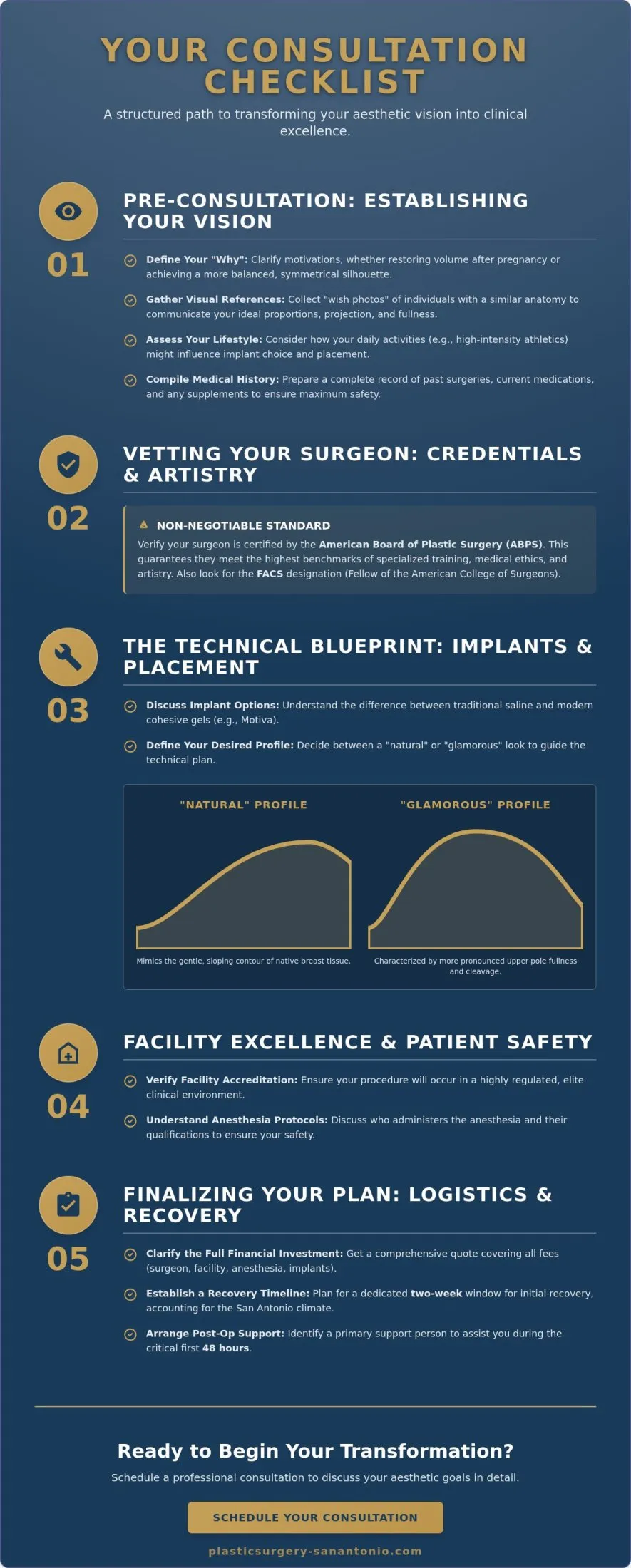
Your aesthetic objective should be distilled into a single, cohesive vision. It’s essential to understand the distinction between two primary aesthetic directions:
Mimics the gentle slope of native tissue; prioritizes a subtle, symmetrical enhancement that integrates seamlessly with your existing anatomy.
Characterized by more pronounced upper fullness and cleavage; a more dramatic projection and defined silhouette.
Are you prioritizing a subtle increase in volume or a significant change in projection? Once you identify these preferences, you can provide your surgeon with a clear roadmap for the technical blueprint, ensuring the final outcome mirrors your internal vision of excellence.
Logistical Readiness
Preparation extends into your immediate post-operative environment, requiring careful coordination of your personal and professional life. In San Antonio, you must account for the regional climate and your specific commitments, ensuring a dedicated two-week window for initial recovery. Identify a primary support person who can assist you during the critical first 48 hours. Finally, review all supplements with your team. Discontinuing specific items, like Vitamin E or certain herbal blends, is a non-negotiable step for minimizing surgical risk and promoting advanced recovery.
Vetting Your Surgeon: Credentials, Artistry, and Clinical Philosophy
Selecting a surgeon is the most consequential decision on your breast augmentation consultation checklist. It requires a discerning eye that looks beyond marketing aesthetics to verify rigorous clinical credentials. The primary standard for any prospective patient must be certification by the American Board of Plastic Surgery (ABPS). This specific designation ensures the surgeon has completed years of specialized training dedicated exclusively to plastic surgery. You should also look for the FACS designation, which indicates the surgeon is a Fellow of the American College of Surgeons. This title signifies a commitment to high ethical standards and surgical excellence that has been peer-reviewed by the most respected medical professionals in the country.
Consistency is the hallmark of true artistry. While a single striking image can be impressive, an elite surgeon’s “Before and After” gallery should demonstrate a pattern of balanced, symmetrical results across various body types. You should look for patients whose pre-operative anatomy mirrors your own to gauge how the surgeon handles specific challenges like tissue laxity or chest wall asymmetry. A meticulous professional will spend time explaining the logic behind their surgical choices, ensuring you understand how they intend to achieve a refined result. When you’re ready to partner with a specialist who balances technical precision with aesthetic grace, seeking plastic surgery in San Antonio ensures your journey begins with an expert dedicated to individualized care.
Safety remains the silent foundation of every successful transformation. You must confirm that your surgeon maintains active hospital privileges for the procedures they perform, even if your surgery is scheduled for a private accredited suite. Hospital privileges serve as a third-party validation of a surgeon’s competence and safety record. During your meeting, a transparent discussion regarding breast augmentation surgery risks is essential. An elite practitioner won’t gloss over these details but will instead provide an educational overview of the protocols they use to mitigate complications. This level of clinical transparency is what separates a high-end medical experience from a mere transaction.
Questions to Ask About Experience and Results
How many breast augmentations do you perform annually in your San Antonio practice?
Do you have a gallery of patients with a similar pre-operative anatomy to mine?
What is your revision rate, and how do you handle dissatisfactory outcomes?
Evaluating the Consultation Experience
The quality of your interaction provides a window into the surgeon’s clinical philosophy. A thorough physical measurement of your breast tissue and chest wall is non-negotiable. This data is essential for the technical planning phase of your breast augmentation consultation checklist. Pay close attention to the tone of the meeting. It should feel educational rather than promotional. An expert surgeon will prioritize your safety, dedicating time to discussing the surgical plan and answering every technical question with clarity.
The Technical Blueprint: Discussing Implants, Incisions, and Placement
“By focusing on projection and width rather than just cubic centimeters, the surgeon ensures the outcome complements your frame with mathematical precision.”
The technical execution of your surgery relies on a series of precise architectural choices made during your initial meeting. A sophisticated breast augmentation consultation checklist must move beyond the simple selection of volume to address the nuances of implant geometry. Your surgeon will analyze your chest wall dimensions to determine the ideal base diameter, ensuring the implant remains centered and proportional. This level of meticulous planning distinguishes a high-end clinical result from a standard procedure, as it accounts for the unique elasticity of your skin and the density of your glandular tissue. By focusing on projection and width rather than just cubic centimeters, the surgeon ensures the outcome complements your frame with mathematical precision.
Choosing the correct implant material involves a detailed discussion of tactile aesthetics and long-term durability. While saline options allow for smaller incisions, silicone gel remains the preferred choice for those seeking a more natural feel and a reduced risk of visible rippling. Modern cohesive gel technology, including the latest generation of implants FDA-approved in September 2025, provides a stable internal structure that mimics the density of natural breast tissue. For a comprehensive understanding of how these devices function over time, this FDA guide on breast implants serves as an essential resource for informed consent. Your surgeon should explain how placement—either submuscular or subglandular—will interact with your specific anatomy to provide the most secure and aesthetically pleasing result.
Selecting Your Implant Profile
Your implant profile determines the “forward” projection of the breast. High-projection implants offer a more dramatic curve for patients with narrow chest walls, while moderate profiles provide a softer, wider appearance. During the consultation, you’ll use “sizers” to visualize these differences in real-time. This process allows you to see how cohesive gel technology maintains its shape under clothing, ensuring your breast augmentation consultation checklist leads to a result that matches your aesthetic vision.
Surgical Technique and Scar Management
Discreet scarring is achieved through strategic incision placement, typically in the inframammary fold, around the areola, or via the transaxillary route. An elite surgeon prioritizes a “no-touch” technique and minimal tissue trauma to accelerate the healing process. They may also discuss the “Internal Bra” technique, which utilizes specialized suturing or supportive materials to reinforce the breast pocket. This advanced methodology provides long-term support, preventing the implants from shifting or “bottoming out” as the years progress.
Facility Excellence and Patient Safety: What to Observe
While the surgeon’s artistic vision is essential, the clinical environment where your transformation occurs serves as the silent guardian of your well-being. A rigorous breast augmentation consultation checklist must include a physical assessment of the surgical facility to ensure it aligns with elite medical standards. Accreditation from bodies such as the American Association for Accreditation of Ambulatory Surgery Facilities (AAAASF) or the Accreditation Association for Ambulatory Health Care (AAAHC) isn’t merely a formality. These certifications ensure the facility adheres to the same stringent safety standards as a major hospital, including rigorous protocols for sterilization, equipment maintenance, and emergency preparedness. Observing the staff’s demeanor and the meticulous cleanliness of the patient areas provides immediate insight into the practice’s commitment to clinical excellence.
The anesthesia team represents another critical layer of your safety profile. Elite practices often prioritize board-certified MD Anesthesiologists to manage your comfort and vital signs throughout the procedure. While CRNAs are highly trained, the presence of a physician anesthesiologist offers an additional level of diagnostic expertise should an unexpected physiological event occur. During your consultation, inquire specifically about the emergency protocols in place and how the team coordinates with local medical centers. If you’re seeking a practice that prioritizes these high-end safety standards, you can schedule a surgical consultation to experience our commitment to patient-centered care firsthand.
The Surgical Environment
Facility Accreditation acts as the definitive benchmark for patient safety, guaranteeing that the operating suite meets national requirements for life-support equipment and surgical precision. You should confirm whether your procedure will be performed in a private, on-site accredited suite or a local San Antonio hospital. On-site suites often provide a higher degree of privacy and a more personalized experience, provided they house advanced monitoring technology and emergency recovery systems equivalent to those found in larger medical institutions. Ask to see the recovery area to ensure it offers the tranquility and professional monitoring required for a safe transition after anesthesia.
Post-Operative Support and Communication
A sophisticated practice provides a seamless transition from the operating room to your home recovery. Your breast augmentation consultation checklist should identify a clear point of contact for the first 24 hours post-surgery. You need to know exactly who to call for after-hours concerns and how emergencies are managed during the evening or weekend. A standard of excellence includes a structured follow-up schedule, typically featuring appointments at one week, one month, six months, and one year. This methodical approach ensures your aesthetic results evolve as planned and any questions regarding your recovery are addressed with clinical authority.
Finalizing Your Plan: Logistics, Recovery, and Next Steps in San Antonio
The conclusion of your consultation marks the transition from theoretical planning to concrete logistical preparation. Completing your breast augmentation consultation checklist involves a thorough review of the financial and temporal commitments required for a successful outcome. A sophisticated surgical quote is comprehensive, extending beyond the surgeon’s fee to include anesthesia services, facility costs, and the specific technology of the implants themselves. It’s essential to understand these components early to ensure your focus remains entirely on your recovery and transformation. Taking the time to review these details allows you to move forward with the calm confidence that characterizes a well-prepared patient.
Recovering in San Antonio requires specific considerations, particularly regarding the regional climate and your immediate environment. The Texas heat can exacerbate post-operative swelling, making a climate-controlled recovery space a non-negotiable requirement for the first 72 hours. You should plan your surgery day with a clear understanding of lead times, as elite practices often have specific preparation windows to ensure every clinical detail is optimized. If you feel any hesitation after your initial meeting, seeking a second opinion is a sign of a diligent patient. A truly professional surgeon will welcome your desire for clarity, as the ultimate goal is your long-term satisfaction and peace of mind.
Financial and Practical Logistics
Your administrative preparation should be as meticulous as the surgical plan itself. Review all available payment schedules and verify which specific costs are bundled into your surgical quote to avoid unexpected expenditures. Logistics also include the practicalities of the first 48 hours, such as coordinating prescription pickups at local San Antonio pharmacies before your surgery date. This proactive approach ensures that your focus remains on rest rather than errands during the initial healing phase. Establishing these details early is a vital component of your breast augmentation consultation checklist.
Preparing for the ‘New You’
The final phase of preparation involves curating your recovery environment and managing your aesthetic expectations. You’ll need to source high-quality post-surgical bras and recovery garments that provide necessary support without compromising comfort. It’s also important to maintain a realistic perspective on the “drop and fluff” phase, where the implants gradually settle into their final, natural position over several weeks. This period of evolution is a normal part of the healing journey toward your refined silhouette.
To begin this transformation with a specialist dedicated to clinical excellence, we invite you to take the next step.
Embarking on Your Personal Aesthetic Journey
Your path toward a refined silhouette is a holistic, high-end journey that demands both technical precision and artistic intuition. By utilizing this breast augmentation consultation checklist, you’ve established a foundation of knowledge that empowers you to make informed decisions about your anatomy and safety. You’ve learned to prioritize American Board of Plastic Surgery certification and to vet facilities for the highest accreditation standards. This preparation ensures that your surgical plan is not a mere transaction but a meticulous architectural strategy tailored specifically to your unique frame.
When you’re ready to transition from planning to action, partnering with a surgeon who embodies these elite standards is the final step. Dr. Gary Lawton, MD, FACS, has been practicing in San Antonio since 1999 and is board-certified by the American Board of Plastic Surgery. His dedication to clinical excellence and subtle, high-quality outcomes provides the absolute trust you deserve. You don’t have to navigate this path alone; expert hands are ready to bring your vision to life with the care and sophistication you expect.
Frequently Asked Questions
How long does a typical breast augmentation consultation last?
A standard consultation generally lasts between 45 and 60 minutes. This duration allows for a comprehensive review of your medical history, a physical examination, and a detailed discussion regarding your aesthetic objectives. It’s a foundational step in your breast augmentation consultation checklist, ensuring that every technical question is answered with the depth and clarity required for a sophisticated surgical plan.
Should I bring photos of results I like to my appointment?
Bringing visual references to your appointment is highly encouraged. These “wish photos” serve as a vital communication tool, helping your surgeon understand your perception of ideal volume, projection, and upper-pole fullness. While every result is tailored to your unique anatomy, these images provide a concrete baseline for discussing the subtle, high-quality outcomes you desire during your elite patient journey.
Is it necessary to see a board-certified plastic surgeon?
Certification by the American Board of Plastic Surgery is a non-negotiable standard for patient safety and surgical artistry. This credential ensures your surgeon has undergone the most rigorous training specifically in plastic surgery. Choosing a board-certified professional provides the quiet confidence that your procedure will be handled with meticulous care, prioritizing medical ethics and clinical excellence over aggressive marketing.
What should I wear to my breast augmentation consultation?
You should wear comfortable, two-piece clothing that is easy to remove. Since a physical examination and precise anatomical measurements are required, a top that buttons or zips in the front is often the most practical choice. This allows for a smooth transition during the clinical assessment while maintaining your privacy and comfort throughout the educational session.
Can I get a price quote over the phone before my consultation?
A precise surgical quote cannot be provided over the phone because each procedure is a bespoke architectural plan. The total investment depends on specific variables such as implant technology, tissue characteristics, and the complexity of the surgical technique. You’ll receive a comprehensive, individualized quote following your physical examination, ensuring complete transparency regarding facility, anesthesia, and surgical fees.
How many consultations should I have before choosing a surgeon?
Most patients find that meeting with one to three board-certified surgeons provides the perspective needed to make a confident decision. The goal is to find a meticulous professional whose clinical philosophy and aesthetic artistry align with your vision. Your breast augmentation consultation checklist should help you identify the surgeon who offers the highest level of transparency and personalized care for your journey.
What is the difference between a cosmetic surgeon and a plastic surgeon?
The primary difference lies in the depth and specificity of medical training. A plastic surgeon has completed at least six years of surgical residency, with a significant portion dedicated exclusively to plastic surgery. Conversely, a cosmetic surgeon may come from any medical background and may not have the same level of specialized education. Board-certified plastic surgeons meet the most elite standards for patient safety and aesthetic finesse.
Will my consultation include a physical exam?
A thorough physical examination is an essential component of the technical blueprint for your surgery. Your surgeon will perform precise measurements of your chest wall and breast tissue to determine the ideal implant geometry and placement. This clinical assessment ensures that the surgical plan is grounded in scientific data, leading to results that are both proportional and anatomically sound.
Disclaimer
Medical & Educational Disclaimer
All content presented on this website, including blog articles, written materials, images, videos, and any associated media, is provided strictly for informational and educational purposes. This content is not intended to serve as medical advice, diagnosis, or treatment, and should not be interpreted as a substitute for consultation with a qualified, licensed healthcare professional.
No doctor–patient relationship is established by your use of this website, engagement with its content, or communication through any digital platform, including contact forms, email, or social media. Medical care is highly individualized, and the information presented here may not apply to your specific condition, anatomy, or circumstances. You should always seek the guidance of a qualified physician regarding any medical concerns, treatments, or decisions.
While every effort is made to ensure accuracy and relevance, medical knowledge evolves rapidly, and no guarantee is made regarding the completeness, reliability, or current applicability of the information provided. The practice and its representatives expressly disclaim any liability for errors, omissions, or outcomes related to the use or misuse of this content.
Surgical & Aesthetic Outcomes Disclaimer
All surgical and non-surgical procedures carry inherent risks. Outcomes vary based on individual factors including anatomy, healing capacity, adherence to post-operative protocols, and overall health status. Any descriptions, discussions, or examples of outcomes presented on this website are illustrative only and should not be interpreted as guarantees of specific results. Before-and-after images, if presented, represent individual cases and do not reflect typical results.
Wellness, Nutrition & Supplementation Disclaimer
Content related to nutrition, supplementation, longevity, metabolic optimization, and integrative or holistic health strategies is provided for educational purposes only. These discussions may include emerging science, theoretical frameworks, or practitioner-based protocols that are not universally accepted within conventional medical standards. Supplements and wellness interventions may interact with medications or underlying health conditions. Consultation with a qualified healthcare provider is strongly recommended prior to initiating any new regimen.
Affiliate & Financial Disclosure
This website may contain links to third-party products, services, or platforms. Some of these links may be affiliate links, meaning a commission may be earned if a purchase is made through them. This comes at no additional cost to you. Product recommendations are based on professional judgment, clinical experience, and research; however, no guarantees are made regarding performance, efficacy, or outcomes. The practice assumes no responsibility for third-party products, services, or claims.
External Links Disclaimer
This website may reference or link to external websites for informational purposes. These sites are not controlled or operated by this practice, and no responsibility is assumed for the accuracy, content, privacy practices, or policies of any third-party website.
Limitation of Liability
By using this website, you acknowledge and agree that you assume full responsibility for any actions taken based on the information provided. Under no circumstances shall the practice, its physicians, affiliates, or representatives be liable for any direct, indirect, incidental, or consequential damages arising from the use of this content.
Consent
By accessing and using this website, you acknowledge that you have read, understood, and agree to this disclaimer in its entirety.