
Breast Augmentation Recovery Day by Day: The Elite Patient Timeline
What if the ultimate success of your aesthetic transformation depended less on the hour spent in the operating room and more on the precise, 90-day architectural evolution of your breast tissue? It’s entirely natural to feel a sense of trepidation regarding post-operative discomfort or the initial, “high and tight” appearance of your new profile before the implants begin to settle. You likely find yourself questioning the exact moment it’s safe to resume your professional responsibilities or return to your high-impact fitness routine without compromising your surgical investment.
We provide the clinical clarity you deserve through a sophisticated, surgeon-led perspective on breast augmentation recovery day by day, ensuring you navigate each milestone with absolute confidence and elite care. By understanding the biological timeline of your healing, you can replace anxiety with the calm assurance that your body is progressing exactly as intended. This comprehensive guide details every phase of the recovery journey, from the management of early inflammation to the final “drop and fluff” transition, providing a structured roadmap for your personal transformation.
Key Takeaways
- Master the art of the “concierge nest” to ensure your immediate environment supports clinical safety and maximum comfort during the first 24 hours.
- Navigate the breast augmentation recovery day by day to maintain calm confidence as your body moves through the peak of initial swelling and muscle tightness.
- Identify the precise milestones for returning to your San Antonio lifestyle, including when it is safe to drive and how to adhere to specific lifting restrictions.
- Understand the biological evolution of the “drop and fluff” phase to correctly anticipate how your implants will settle into their final, natural position.
- Discover how Dr. Gary Lawton’s Rapid Recovery philosophy and FACS standing create an elite safety net for achieving sophisticated, high-quality outcomes.
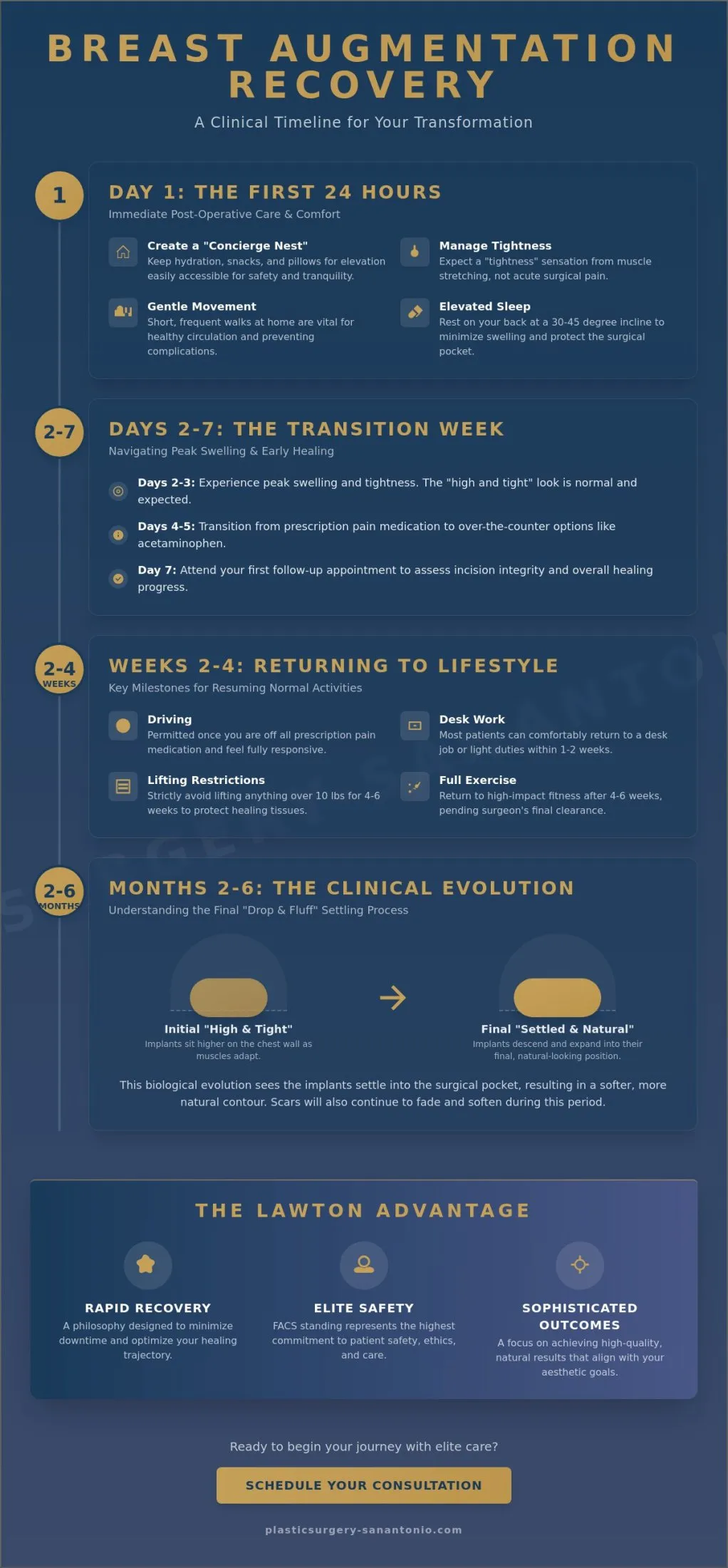
Day 1
“Concierge Nest” setup, anesthesia clearance, surgical compression bra, 30–45° incline rest.
Days 2–7
Peak edema days 2–3, shower clearance at 48hr, OTC pain management by day 4–5, Day 7 follow-up.
Weeks 2–4
5–10 lb lifting limit, scar protocol begins day 14, sports bra transition by week 4, lower-body-only workouts.
Months 2–6
“Drop and fluff” settling, nerve regeneration (“zingers”), full activity green light at month 2, final bra sizing at month 4–5.
The Immediate Post-Operative Window: Day 1 and the First 24 Hours
“Patients often report a sensation of intense ‘tightness’ across the chest wall — it’s important to recognize this as the natural stretching of the pectoralis muscle rather than acute surgical pain.”
The first 24 hours of your aesthetic journey represent a pivotal phase where clinical precision meets the comfort of your private residence. Prior to your procedure, we recommend establishing a “Concierge Nest” designed for both safety and tranquility. This dedicated recovery space should include easily accessible hydration, nutrient-dense snacks, and a supportive recliner or wedge pillow system to maintain elevation. During the initial six hours post-surgery, you’ll likely navigate a transient anesthesia fog as your system clears the sedative agents. Throughout this early stage of post-surgical recovery, the constant use of your surgical compression bra is essential to stabilize the initial implant position and provide necessary structural support.
To better understand the nuances of the healing process, watch this expert overview:
Proactive movement is a cornerstone of our recovery philosophy. While rest is your priority, short and frequent walks through your home are vital for maintaining healthy circulation and preventing post-operative complications. This deliberate approach to your breast augmentation recovery day by day ensures that your healing remains on a steady, predictable trajectory from the moment you leave our facility.
Pain Management and Clinical Comfort
Dr. Gary Lawton employs a sophisticated, multi-modal pain management protocol that prioritizes patient comfort while significantly reducing reliance on traditional opioids. Patients often report a sensation of intense “tightness” across the chest wall; it’s important to recognize this as the natural stretching of the pectoralis muscle rather than acute surgical pain. Maintaining optimal hydration and choosing light, protein-rich meals will support your metabolic needs during this critical window. We find that small, frequent snacks are often better tolerated than larger meals as your digestive system returns to its normal rhythm after the procedure.
Your First Night: Sleep Positioning
Resting at a 30 to 45 degree incline is a non-negotiable requirement for effectively managing post-operative edema. This elevated posture facilitates lymphatic drainage and minimizes the pressure exerted on the newly formed surgical pocket. The surgical pocket is the precisely dissected anatomical space within the breast tissue or submuscular plane that houses and secures the implant. To preserve this delicate architecture, place pillows along your sides to prevent rolling during the night. This ensures that you remain on your back, protecting the incision sites and allowing the implants to settle without external interference as you continue your breast augmentation recovery day by day.
The Transition Week: Day 2 through Day 7
Days two and three typically represent the physiological peak of your initial healing journey. During this specific window of your breast augmentation recovery day by day, you’ll likely experience the maximum extent of post-operative edema and muscular tightness. It’s during these 48 hours that the “high and tight” aesthetic is most pronounced. Your implants may appear positioned higher on the chest wall than anticipated; however, this is a standard clinical expectation as the pectoralis muscles and overlying skin adapt to the new volume. This temporary positioning is a natural part of the postoperative recovery stages and should not cause alarm.
By day four or five, most patients find they can successfully transition from prescription discomfort management to over-the-counter options like acetaminophen or ibuprofen. This shift marks a significant milestone in your autonomy and physical comfort. As you approach the end of your first week, your focus shifts toward the day seven follow-up appointment. This clinical evaluation is vital for assessing incision integrity and ensuring that your internal healing is progressing according to our precise surgical plan. If you have questions about your specific timeline, our team is always available to provide a personalized recovery assessment.
Showering and Incision Care
Most patients receive clearance to shower 48 hours after surgery. It’s essential to use lukewarm water rather than hot, as excessive heat can exacerbate swelling or cause lightheadedness. You should avoid direct water pressure on the incisions; instead, allow soapy water to run gently over the area. When drying, use a clean, soft towel to pat the skin dry rather than rubbing it. Your pectoral muscles are currently in a state of protective guarding, so keeping your movements fluid and gentle will prevent unnecessary strain on the internal repair site.
Emotional Recovery: The “Post-Op Blues”
It’s quite common to experience a brief dip in mood between days three and five. This “post-op blues” phenomenon is a documented physiological response to the combination of anesthesia clearance, fluctuating hormone levels, and the temporary physical limitations of surgery. When you look in the mirror during this week, the results may feel “alien” due to the initial swelling. Remember that your current appearance is a work in progress. By day five, light movement such as a leisurely ten-minute walk around your home can significantly improve both circulation and your emotional outlook. Staying hydrated and maintaining a focus on your long-term aesthetic goals will help you navigate this transient phase with confidence.
Weeks 2 to 4: Returning to the San Antonio Lifestyle
“Adhering to a strict five to ten pound lifting limit remains essential to protect the integrity of the internal sutures and prevent any early displacement of the implants.”
As you progress into the second week, the focus of your Breast augmentation recovery time shifts from acute healing to the meticulous reintegration of your daily routine. Adhering to a strict five to ten pound lifting limit remains essential during this period to protect the integrity of the internal sutures and prevent any early displacement of the implants. This restriction ensures that the delicate internal repair sites are not compromised by sudden muscular strain. Most patients find that they can safely return to driving once they’ve ceased all prescription pain medications and regained the chest mobility required for rapid steering maneuvers.
By day fourteen, we typically initiate Dr. Lawton’s specialized scar management protocol. This involves the application of medical-grade topical treatments designed to optimize the maturation of your incisions and ensure they fade into subtle, nearly imperceptible lines. As you reach the conclusion of week four, you’ll experience the welcome transition from your initial surgical compression garment into supportive, non-underwire sports bras. This milestone marks a significant step in your breast augmentation recovery day by day, as the tissues begin to soften and accommodate your new profile with greater ease.
Work and Social Calendar Re-entry
The timeline for returning to professional life varies significantly based on the physical demands of your role. Patients with sedentary office positions often feel capable of returning within seven to ten days, provided they manage their “surgical fatigue” appropriately. This fatigue is a natural physiological response as your body diverts significant caloric energy toward cellular repair and tissue integration. When re-entering social circles, many patients choose soft, layered clothing that discreetly accommodates the remaining “high and tight” volume while the implants continue their gradual descent. It’s perfectly normal to feel a temporary dip in your social stamina during week three, so we recommend pacing your engagements accordingly.
Early Exercise Integration
Fitness remains a priority for many of our San Antonio patients, but reintegration must be handled with clinical caution. We permit a “lower body only” rule during this phase, allowing for stationary cycling or brisk walking that does not involve upper body engagement. High-impact cardiovascular activities, such as running or HIIT, are strictly prohibited until at least week six to avoid unnecessary trauma to the healing breast pocket. During week three, any significant increase in blood pressure can cause vasodilation, which potentially leads to increased swelling or late-stage bruising in the fragile healing tissues. Maintaining a steady, low-impact routine ensures you stay active without jeopardizing your sophisticated aesthetic results.
The Clinical Evolution: Month 2 through Month 6
Entering the second month marks a significant transition from acute healing to the sophisticated biological maturation of your results. While the initial stages of your breast augmentation recovery day by day focus on wound closure and inflammation management, this extended window is defined by internal tissue remodeling and the architectural settling of the implants. Patients often notice that by month three, the implants begin to move and feel much more like natural breast tissue. This is the stage where the “surgical” feel dissipates, replaced by a softer, more integrated aesthetic that mirrors your body’s natural contours.
During this period, you may experience the phenomenon of nerve regeneration. This often manifests as temporary numbness or sharp, fleeting sensations colloquially known as “zingers.” These are positive clinical indicators that the sensory nerves are successfully re-establishing pathways within the newly formed breast pocket. Simultaneously, your incisions will undergo long-term scar maturation. They typically transition from a pink, slightly raised appearance to a pale, flat, and discreet line as the collagen fibers realign and the vascularity of the scar tissue diminishes.
The specific moment when the implant settles into the lower portion of the surgical pocket, creating a natural fullness in the lower pole of the breast.
Occurs as the overlying breast tissue and pectoralis muscles finally relax and soften over the implant, allowing it to project naturally.
Understanding the “Drop and Fluff”
The “Drop and Fluff” process is a hallmark of high-quality breast augmentation that requires patient patience. “Drop” refers to the specific moment when the implant settles into the lower portion of the surgical pocket, creating a natural fullness in the lower pole of the breast. “Fluff” occurs as the overlying breast tissue and pectoralis muscles finally relax and soften over the implant, allowing it to project naturally. It’s important to understand that one breast may drop faster than the other. This asymmetrical healing is a normal reality of the human body’s unique biological pace; one side may take several weeks longer to reach its final position than its counterpart.
Resuming Full Activity
By month two, most patients receive the clinical “green light” to resume their full athletic pursuits. This includes heavy lifting, chest-specific weight training, and high-impact sports that were previously restricted. However, we advise waiting until month four or five before investing in a permanent wardrobe of high-end bras. Because the “fluffing” process continues to alter the breast’s projection and base width, your final bra size may not stabilize until this later stage. Our team remains dedicated to your long-term success, and the six-month follow-up appointment is a critical component of our safety protocol to monitor implant integrity and ensure your satisfaction remains absolute.
If you’re ready to begin this transformative process, we invite you to schedule your private consultation to discuss your aesthetic goals.
The Lawton Advantage: Advanced Recovery in San Antonio
The successful realization of your aesthetic goals depends significantly on the surgical philosophy and technical precision of your chosen surgeon. Dr. Gary Lawton, MD, FACS, employs a “Rapid Recovery” philosophy that prioritizes meticulous tissue handling and advanced dissection techniques to minimize post-operative trauma. This technique-driven approach ensures that your breast augmentation recovery day by day is characterized by less discomfort and a more predictable return to your daily routine. By focusing on surgical finesse during the procedure, we significantly reduce the internal inflammation that often leads to prolonged downtime.
Living in Central Texas introduces unique environmental factors that can influence your healing timeline. San Antonio’s characteristic heat and humidity require specific clinical strategies to manage systemic hydration and localized swelling. We provide our patients with tailored protocols to navigate the South Texas climate, ensuring that external temperatures don’t exacerbate post-operative edema. This localized expertise allows us to refine your recovery plan based on the specific lifestyle demands of our region, from maintaining electrolyte balance to optimizing your home recovery environment for the Texas summer.
Why Credentials Matter for Recovery
Choosing a surgeon with Board Certification and FACS standing provides an essential safety net for your transformation. These accolades aren’t merely titles; they represent a verified commitment to the highest standards of surgical ethics and clinical excellence. Surgical precision during the initial procedure is the most critical factor in reducing post-operative bruising and swelling. When a surgeon operates with the expertise of a Fellow of the American College of Surgeons, the resulting reduction in tissue disruption allows your body to focus its energy on cellular repair rather than managing extensive trauma.
Our localized practice in San Antonio offers the distinct advantage of immediate, in-person follow-up care within an elite, state-of-the-art facility. Healing is a dynamic process, and having a dedicated surgical team nearby ensures that any questions regarding your breast augmentation recovery day by day are addressed with clinical authority and personal warmth. Our sterile, high-end environment is designed to support the most sophisticated recovery standards, providing you with peace of mind as you move through each phase of the Lawton Patient Journey.
Next Steps for Your Transformation
Your journey toward a refined silhouette begins with a comprehensive, one-on-one consultation where Dr. Lawton will develop your individualized surgical plan. We encourage you to prepare a list of questions regarding your specific anatomical goals and any lifestyle-related recovery concerns. Our team is dedicated to providing the educational clarity you need to move forward with absolute confidence in your surgical choice.
Secure Your Aesthetic Evolution
Navigating the intricate nuances of breast augmentation recovery day by day requires more than mere patience; it necessitates a partnership with a surgical authority dedicated to clinical excellence. By respecting the precise biological milestones of the settling phase and adhering to a structured reintegration of your lifestyle, you ensure your aesthetic results are both sophisticated and enduring. Dr. Gary Lawton, MD, FACS, has served the San Antonio and Central Texas communities since 1999, providing the technical finesse and academic weight expected of a premier plastic surgery practice. His commitment to the Rapid Recovery philosophy ensures that your healing journey is managed with the same artistic precision as the surgical procedure itself.
When you align your transformation with elite credentials and a meticulous philosophy of care, you replace post-operative anxiety with the calm assurance of expert hands. We invite you to transition from the planning phase to the reality of your new silhouette.
Frequently Asked Questions
What is the most painful day of breast augmentation recovery?
Days two and three are typically the most physically demanding as post-operative inflammation peaks and the pectoralis muscles begin to adapt to the new implant volume. While our multi-modal pain protocols are designed to mitigate acute discomfort, you may experience significant pressure and tightness during this 48 hour window. Most patients find that their comfort levels improve substantially by the fourth day as the initial surgical swelling starts to subside.
How long do I need to take off work after a boob job in San Antonio?
Most patients return to sedentary office environments within seven to ten days of their procedure. If your professional responsibilities require significant physical reaching, lifting, or high levels of stamina, we recommend a minimum of two to three weeks of leave. This duration ensures that you don’t compromise the internal surgical pocket or incision integrity during the most delicate phase of your biological healing.
When can I sleep on my side or stomach after breast implants?
You must remain on your back with your torso elevated for at least four to six weeks before side sleeping is permitted. Stomach sleeping is generally restricted for eight to twelve weeks to prevent excessive pressure on the implants and the inframammary fold. Adhering to these positioning requirements is essential for maintaining the symmetry of your results and protecting the internal architectural repair during the first few months.
Why do my breasts look so high and square right after surgery?
This “high and tight” appearance occurs because the pectoralis major muscle is naturally tight and exerts downward pressure on the implant while the lower breast tissue is still expanding. As you navigate your breast augmentation recovery day by day, the muscle will gradually relax and the lower pole of the breast will soften. This biological transition, often called the “drop and fluff,” eventually results in a more natural, teardrop shaped contour.
When can I start exercising again after breast augmentation?
Light walking is encouraged from the first day to support circulation, but high impact cardio and chest specific weight training are restricted until week six. You may typically begin “lower body only” workouts, such as stationary cycling, after the second week provided you don’t engage your upper body. Waiting until the six week milestone prevents elevated blood pressure from causing late stage swelling or unnecessary trauma to the healing tissues.
How long does the “drop and fluff” process actually take?
The initial settling of the implants typically occurs between month three and month six, though the final aesthetic refinement can continue for up to a full year. This timeline allows the skin and glandular tissue to accommodate the new volume while the implants reach their permanent anatomical position. You’ll notice a gradual increase in projection and softness as the internal tissues settle into their final, sophisticated profile.
When is it safe to wear an underwire bra again?
We advise patients to wait at least six to eight weeks before wearing an underwire bra to avoid irritation of the healing incision sites. Constant pressure from a wire can disrupt the maturation of the scar tissue and potentially alter the position of the inframammary fold. Once your clinical evaluation confirms that the tissues have sufficiently matured, you can transition from supportive sports bras to traditional underwire lingerie.
What are the signs of a complication I should look for during recovery?
You should contact our surgical team immediately if you experience localized heat, a persistent fever over 101 degrees, or sudden and significant asymmetry in breast volume. While most patients enjoy a smooth healing journey, these indicators can signal an infection or a hematoma that requires prompt clinical attention. Maintaining open communication with our office ensures that your recovery remains on a safe trajectory toward your desired aesthetic outcome.
Disclaimer
Medical & Educational Disclaimer
All content presented on this website, including blog articles, written materials, images, videos, and any associated media, is provided strictly for informational and educational purposes. This content is not intended to serve as medical advice, diagnosis, or treatment, and should not be interpreted as a substitute for consultation with a qualified, licensed healthcare professional.
No doctor–patient relationship is established by your use of this website, engagement with its content, or communication through any digital platform, including contact forms, email, or social media. Medical care is highly individualized, and the information presented here may not apply to your specific condition, anatomy, or circumstances. You should always seek the guidance of a qualified physician regarding any medical concerns, treatments, or decisions.
While every effort is made to ensure accuracy and relevance, medical knowledge evolves rapidly, and no guarantee is made regarding the completeness, reliability, or current applicability of the information provided. The practice and its representatives expressly disclaim any liability for errors, omissions, or outcomes related to the use or misuse of this content.
Surgical & Aesthetic Outcomes Disclaimer
All surgical and non-surgical procedures carry inherent risks. Outcomes vary based on individual factors including anatomy, healing capacity, adherence to post-operative protocols, and overall health status. Any descriptions, discussions, or examples of outcomes presented on this website are illustrative only and should not be interpreted as guarantees of specific results. Before-and-after images, if presented, represent individual cases and do not reflect typical results.
Wellness, Nutrition & Supplementation Disclaimer
Content related to nutrition, supplementation, longevity, metabolic optimization, and integrative or holistic health strategies is provided for educational purposes only. These discussions may include emerging science, theoretical frameworks, or practitioner-based protocols that are not universally accepted within conventional medical standards. Supplements and wellness interventions may interact with medications or underlying health conditions. Consultation with a qualified healthcare provider is strongly recommended prior to initiating any new regimen.
Affiliate & Financial Disclosure
This website may contain links to third-party products, services, or platforms. Some of these links may be affiliate links, meaning a commission may be earned if a purchase is made through them. This comes at no additional cost to you. Product recommendations are based on professional judgment, clinical experience, and research; however, no guarantees are made regarding performance, efficacy, or outcomes. The practice assumes no responsibility for third-party products, services, or claims.
External Links Disclaimer
This website may reference or link to external websites for informational purposes. These sites are not controlled or operated by this practice, and no responsibility is assumed for the accuracy, content, privacy practices, or policies of any third-party website.
Limitation of Liability
By using this website, you acknowledge and agree that you assume full responsibility for any actions taken based on the information provided. Under no circumstances shall the practice, its physicians, affiliates, or representatives be liable for any direct, indirect, incidental, or consequential damages arising from the use of this content.
Consent
By accessing and using this website, you acknowledge that you have read, understood, and agree to this disclaimer in its entirety.