
Minimizing Tummy Tuck Scars: The Elite Guide to Refined Recovery in 2026
The distinction between a life spent concealing your midsection and the absolute freedom of a low-rise bikini often rests upon a single millimeter of surgical precision and the clinical sophistication of your recovery protocol. You’ve likely seen the distressing, high-tension results shared on social media and felt a valid sense of anxiety about your own aesthetic outcome. It’s entirely natural to feel overwhelmed by the conflicting advice surrounding over-the-counter creams or the fear that a permanent mark might dictate your future wardrobe choices.
We believe that achieving a refined, nearly invisible result is a deliberate outcome of elite medical expertise rather than a matter of chance. This guide provides the professional surgical insights and evidence-based protocols required for minimizing tummy tuck scars to the highest clinical standards. You’ll discover how advanced tension-management techniques, combined with a structured 12-month healing roadmap and medical-grade silicone therapy, ensure your incision remains discreetly hidden and beautifully matured.
Key Takeaways
- Navigate the 12-month maturation cycle with confidence by understanding how your incision naturally evolves from early healing to its final, discreet appearance.
- Discover how elite surgical techniques, such as multi-layered suturing and precision placement, serve as the technical foundation for minimizing tummy tuck scars.
- Evaluate the clinical efficacy of medical-grade silicone protocols that prioritize occlusion and hydration to achieve a more refined and supple outcome.
- Implement specific lifestyle adjustments, including targeted UV protection and nutritional optimization, to safeguard your recovery in the unique San Antonio climate.
- Establish the critical criteria for selecting a board-certified surgeon whose technical finesse and professional legacy ensure a sophisticated, patient-centered journey.
The Anatomy of Healing: Understanding the Tummy Tuck Scar Maturation Cycle
“Patience remains the most critical component of this elite recovery journey — you must view your scar as a living tissue that requires consistent stewardship rather than a fixed mark.”
A tummy tuck scar is a permanent but highly manageable byproduct of the skin excision and tissue tightening required during an Abdominoplasty procedure. While the initial incision line is a necessary trade-off for a contoured abdomen, its final appearance is never static. The healing process is a dynamic biological journey where the tissue undergoes significant transformations in texture, elevation, and pigment over a full year. Achieving a sophisticated result requires a deep understanding of this maturation cycle, as the strategies for minimizing tummy tuck scars change depending on which phase of healing you’re currently navigating.
To better understand the nuances of this recovery timeline, watch this helpful clinical overview:
Patience remains the most critical component of this elite recovery journey. You must view your scar as a living tissue that requires consistent stewardship rather than a fixed mark. By aligning your expectations with the biological reality of collagen remodeling, you can avoid the common anxiety that arises when the scar doesn’t look “perfect” in the first few months.
First 90 Days
Incision appears pink, deep red, or slightly purple. Hypervascularized tissue phase; appearance may “worsen” around week 6.
Focus: Protect from mechanical stress and maintain hydration.
6–18 Months
Type III collagen replaced by stronger, organized Type I fibers. Color shifts from vivid red to faded silvery-white.
Focus: Consistent clinical protocols prevent stalling or thickening.
The First 90 Days: From Incision to Immature Scar
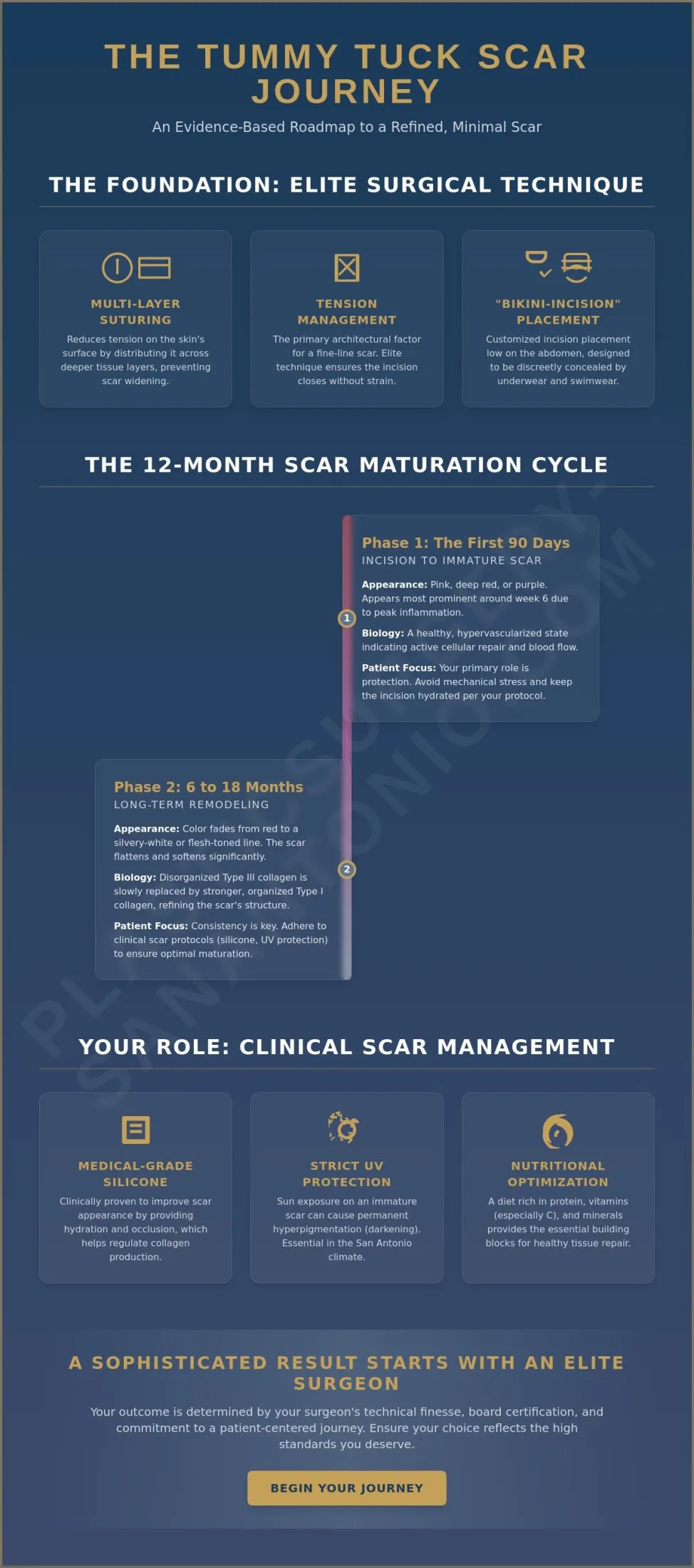
During the initial three months, your body is in a state of high alert. The incision will typically appear pink, deep red, or even slightly purple. This isn’t a sign of poor healing; it’s a vital indicator of healthy blood flow and active cellular repair. Many patients notice their scars look “worse” around week 6 than they did at week 2. This occurs because the inflammatory response peaks during this window, causing the tissue to appear more prominent. An immature scar represents a hypervascularized tissue phase where the body prioritizes rapid cellular recruitment and blood flow over long-term structural refinement. During this stage, your primary focus is on protecting the delicate new skin from mechanical stress and ensuring the wound remains hydrated.
The Long-Term Remodeling Phase (6–18 Months)
As you move past the six-month mark, the body begins the sophisticated work of remodeling. It slowly replaces the temporary, disorganized Type III collagen fibers with stronger, more organized Type I fibers. This transition is what leads to the scar’s eventual flattening and softening. You’ll observe the color shifting from a vivid red to a faded, silvery-white or flesh-toned line that blends into your natural skin. However, this progress isn’t guaranteed. Factors like chronic inflammation, excessive tension on the incision line, or premature sun exposure can stall maturation and lead to thickening. Consistent adherence to clinical protocols for minimizing tummy tuck scars during this late stage is what separates an average result from a truly refined, low-profile outcome.
Surgical Finesse: How Elite Placement and Technique Dictate Results
The biological maturation of a scar is inevitable, but the ultimate aesthetic outcome is fundamentally determined in the operating suite. While the healing timeline discussed previously provides a framework for recovery, the surgeon’s technical finesse serves as the primary architect for minimizing tummy tuck scars. An elite surgical approach moves beyond simple skin excision. It involves a meticulous, multi-layered strategy designed to manage tension and ensure the most discreet placement possible. Understanding the various Types of tummy tuck incisions is essential for setting realistic expectations for your personal transformation.
The Art of the Low-Profile Incision
Dr. Lawton utilizes a “Bikini-Incision” philosophy that prioritizes anatomical customization. By carefully evaluating each patient’s unique hip structure and skin elasticity, he determines the lowest possible placement for the incision. This ensures the resulting line remains entirely concealed within even high-cut swimwear or athletic gear. The technical difference between a standard closure and an elite aesthetic closure lies in the precision of the curve. A sophisticated surgeon doesn’t simply draw a straight line; they tailor the incision to follow the natural contours of the body. This prevents the scar from appearing artificial or misplaced as the tissue settles over time.
Internal Suture Management and Muscle Repair
A flat, low-profile scar is only possible when the underlying structures provide adequate support. Repairing the abdominal wall, specifically addressing diastasis recti, creates a stable foundation that prevents the skin from bulging or placing undue stress on the incision. Dr. Lawton employs progressive tension sutures to anchor the deeper tissue layers to the abdominal wall. This advanced methodology offloads tension from the surface skin, which is the most effective way of minimizing tummy tuck scars and preventing “railroad” marks or widening. By securing the tissue internally, the surgeon ensures the scar doesn’t migrate upward during the months of remodeling.
This “no-tension” closure technique is what separates a professional, clinical result from a common surgical mark. If you’re seeking this level of technical precision for your own journey, you can schedule a private consultation to review your specific anatomical needs. This individualized planning ensures your results reflect the highest standards of modern plastic surgery while prioritizing your long-term aesthetic confidence.
Clinical Scar Management Protocols: Beyond Over-the-Counter Creams
“Silicone mimics the skin’s natural barrier to regulate collagen — medical-grade silicone remains the gold standard for scar management due to its unique ability to provide both occlusion and hydration.”
The period following your surgical procedure represents a critical window where clinical-grade interventions can significantly influence the final aesthetic quality of your skin. While the technical excellence of the incision placement is paramount, the subsequent phase of recovery requires a transition from surgical precision to rigorous post-operative stewardship. Relying on generic, over-the-counter ointments often yields inconsistent or negligible results. Instead, we advocate for a scientifically backed approach for minimizing tummy tuck scars that utilizes medical-grade materials to regulate the body’s natural healing response. For those seeking a broader understanding of various clinical options, Cleveland Clinic’s guide to scar healing offers a comprehensive overview of the standard medical interventions used in modern practice.
Sheets or gels provide occlusion and hydration; sheeting offers superior constant pressure to flatten raised tissue.
Target redness and texture irregularities by breaking down dense collagen and reducing hypervascularity. Best months 3–6.
Intense Pulsed Light treats post-surgical hyperpigmentation — particularly valuable in the sunny South Texas climate.
The Gold Standard: Silicone Sheeting and Gels
Medical-grade silicone remains the gold standard for scar management due to its unique ability to provide both occlusion and hydration. By creating a protective micro-environment, silicone sheets or specialized gels increase the temperature and hydration levels of the stratum corneum, which signals the body to suppress the overproduction of collagen-forming cells. Silicone mimics the skin’s natural barrier to regulate collagen. This therapy typically begins once the incision has fully closed and the initial sutures are removed, ensuring the tissue is stable enough to tolerate topical applications. While gels offer convenience for active lifestyles, medical-grade sheeting provides a superior level of constant pressure that’s particularly effective for flattening raised or hypertrophic tissue during the first 24-hour cycles of wear.
Laser Resurfacing and Energy-Based Treatments
For patients who desire a truly nearly invisible outcome, advanced energy-based treatments offer a level of refinement that topicals alone cannot achieve. Fractionated CO2 lasers or V-Beam therapies are strategically utilized to target redness and texture irregularities by breaking down dense collagen bundles and reducing hypervascularity. IPL (Intense Pulsed Light) serves as an excellent modality for treating post-surgical hyperpigmentation, particularly in the sunny South Texas climate where UV exposure can darken healing tissue. Early intervention with these technologies, typically between months 3 and 6, can yield superior long-term results by guiding the remodeling process before the scar tissue becomes fully mature and less responsive to light-based correction.
Dr. Lawton develops individualized scar therapy plans that evolve alongside your recovery, ensuring that each intervention matches the specific biological needs of your tissue at every stage. This meticulous attention to detail is a hallmark of an elite aesthetic journey, transforming a standard recovery into a sophisticated process of skin refinement. By combining these clinical protocols with the surgical finesse established in the operating room, we provide a holistic pathway toward achieving a low-profile, bikini-hidden result that empowers your long-term confidence.
The Patient’s Role: Lifestyle Optimization in the San Antonio Climate
While the technical finesse of the surgeon and the application of clinical-grade topicals establish the foundation for a refined result, the patient’s daily stewardship remains the final determinant of success. Minimizing tummy tuck scars requires a disciplined commitment to lifestyle optimization, particularly when navigating the environmental challenges of the South Texas region. Your body requires a specific internal environment to facilitate the complex process of collagen remodeling, meaning your nutritional choices and hydration levels are just as influential as your surgical sutures. By viewing your recovery as an active partnership, you ensure that the meticulously placed incision matures into a discreet, low-profile mark.
Nutritional foundations are paramount during the first 12 months of healing. To support robust tissue repair, your diet should prioritize high-quality protein, which provides the essential amino acids for cellular regeneration. Vitamin C and Zinc serve as critical co-factors in collagen synthesis; a deficiency in these micronutrients can lead to fragile scar tissue that is more prone to widening. Maintaining cellular hydration is equally vital, as well-hydrated skin possesses the elasticity required to withstand the subtle movements of daily life without placing undue stress on the healing incision.
UV Protection and San Antonio Sun Safety
The intense UV radiation characteristic of the San Antonio climate poses a significant threat to an immature scar. Sunlight triggers the overproduction of melanin in healing tissue, leading to permanent hyperpigmentation that can make a scar appear dark, muddy, or prominent. You must protect the incision from direct sun exposure for at least one full year. While clothing provides some defense, we recommend using physical blockers containing zinc oxide or titanium dioxide rather than chemical sunscreens. Physical blockers offer more stable protection without irritating sensitive post-surgical skin. During a South Texas summer, the combination of heat and sweat can also cause localized irritation, making it essential to keep the area cool and dry to prevent inflammatory spikes that could stall the maturation process.
Activity Modification to Prevent Mechanical Stress
The most common cause of widened or stretched scars is the premature return to strenuous activity. Mechanical stress on a fresh incision forces the body to produce thicker, tougher collagen to prevent wound separation, which results in a more visible mark. You must strictly adhere to activity restrictions, particularly regarding core-heavy exercises or heavy lifting, for the first six to eight weeks. Stretching the midsection too early pulls on the delicate fibers of the healing line and can compromise the integrity of the repair. Consistent use of compression garments is non-negotiable, as these medical devices provide the external support needed to offload tension from the skin’s surface.
If you’re ready to begin this meticulously managed journey toward a more confident silhouette, request your surgical consultation to discuss a personalized recovery plan tailored to your lifestyle.
Choosing an Elite Plastic Surgeon for a Sophisticated Outcome
The ultimate success of your aesthetic transformation depends fundamentally on the hands that perform the surgery and the clinical philosophy that guides your recovery. While we’ve discussed the biological maturation of tissue and the patient’s role in stewardship, the search for a specialist who prioritizes minimizing tummy tuck scars requires a discerning look at verified credentials and long-term surgical legacies. The distinction between a standard surgical result and a truly sophisticated outcome often lies in the surgeon’s ability to harmonize technical precision with an individualized aesthetic vision. You shouldn’t view your procedure as a mere transaction, but rather as a holistic, high-end journey that begins with the selection of a meticulous professional.
The Importance of FACS and Board Certification
Board certification by the American Board of Plastic Surgery is a non-negotiable standard that ensures your surgeon has undergone the most rigorous training and peer-review processes in the field. When a surgeon also carries the FACS designation, it indicates they’re a Fellow of the American College of Surgeons, a distinction that signals a commitment to the highest ethical and technical standards. Dr. Lawton has practiced in San Antonio since 1999, cultivating a legacy of clinical excellence and refined results that spans over two decades. This level of experience is what allows a specialist to avoid common pitfalls such as “dog ears,” which are redundant pockets of tissue at the ends of the incision, or incorrectly placed scars that sit too high on the abdomen. Technical finesse is the byproduct of elite training combined with thousands of hours in the operating suite, ensuring that every suture contributes to a low-profile, nearly invisible result.
Your Consultation: Designing Your Personal Transformation
During your private consultation, you should feel empowered to review before-and-after galleries with a specific focus on scar placement and the quality of the matured incision line. An elite surgeon will be transparent about their methodology for minimizing tummy tuck scars and will explain how they tailor the curve of the incision to your specific hip structure. You should ask detailed questions about their multi-layered closure techniques and their specific protocols for post-operative laser or silicone therapy. Dr. Lawton creates a customized plan based on your unique skin type, elasticity, and long-term aesthetic goals, ensuring that your recovery is as refined as the surgery itself.
Choosing a surgeon who treats their work as both a science and an art is the most effective way to ensure your confidence remains unshakeable when you finally step into your favorite swimwear.
Stepping Into Your Refined Aesthetic Future
Achieving a nearly invisible surgical mark is a deliberate outcome that requires a harmonious blend of clinical excellence and dedicated patient stewardship. You now understand that the maturation process is a year-long biological journey where your daily choices in the San Antonio sun are just as vital as the initial incision placement. By prioritizing medical-grade silicone protocols and adhering to precise activity modifications, you ensure your results remain as low-profile and discreet as intended.
Dr. Lawton has been board-certified by the American Board of Plastic Surgery since 1999 and is a Fellow of the American College of Surgeons (FACS). His specialized focus on “Bikini-Line” incision placement ensures that your surgical plan is meticulously tailored to your unique anatomy. If you’re ready to commit to the high-level protocols required for minimizing tummy tuck scars, we invite you to begin this transformative journey with a professional who balances scientific rigor with artistic finesse.
Frequently Asked Questions
Will my tummy tuck scar ever completely disappear?
A tummy tuck scar is a permanent anatomical change and will never completely disappear. However, through meticulous surgical technique and clinical-grade recovery protocols, the incision line typically matures into a very thin, silvery-white line that blends into the surrounding tissue. By the 12-month mark, most patients find their results are virtually imperceptible when viewed from a standard distance, achieving a sophisticated and natural appearance.
When can I start applying scar cream after my abdominoplasty?
You may typically begin applying specialized scar gels or medical-grade silicone once the incision has fully closed and any external sutures or surgical glue have been removed. This milestone usually occurs between two and three weeks post-operation. It’s essential to wait for total wound closure to prevent irritation or potential infection within the deeper tissue layers, ensuring the healing environment remains sterile and stable.
How can I prevent my tummy tuck scar from turning dark or brown?
Preventing hyperpigmentation requires a rigorous commitment to UV protection for at least one full year following your procedure. The intense San Antonio sun can trigger melanin production in healing tissue, causing permanent darkening that is difficult to reverse. Utilizing physical sunblocks containing zinc oxide or titanium dioxide provides a stable barrier that protects the delicate, remodeling skin from solar damage and ensures a flesh-toned result.
Does the ‘mini’ tummy tuck always have a smaller scar than a full tummy tuck?
A mini tummy tuck generally involves a shorter incision than a full abdominoplasty because it focuses exclusively on the area below the navel. However, the exact length of the scar is determined by the amount of excess skin that must be excised to achieve a smooth, contoured result. In cases with significant lateral laxity, even a mini procedure may require a slightly longer incision to avoid tissue bunching at the ends of the repair.
Can I get a tattoo over my tummy tuck scar to hide it?
You can pursue medical or decorative tattooing once the scar has reached full maturation, which typically takes twelve to eighteen months. Attempting to tattoo an immature, pink scar can lead to poor ink retention and potential tissue trauma. A fully remodeled, flat scar serves as a much more stable canvas for camouflage or artistic coverage, allowing for a refined aesthetic outcome that aligns with your personal style.
What should I do if my scar feels itchy or raised during recovery?
Itching and slight elevation are common during the inflammatory phase of healing as nerves regenerate and collagen is deposited. Utilizing medical-grade silicone sheeting provides the necessary occlusion to flatten raised areas and soothe sensitivity. If the scar remains persistently itchy or becomes significantly thickened, professional interventions such as localized steroid injections or laser therapy can regulate the remodeling process and assist in minimizing tummy tuck scars.
How long do I need to stay out of the San Antonio sun after surgery?
Direct sun exposure on the incision should be avoided for a minimum of twelve months to ensure optimal results in minimizing tummy tuck scars. While you can enjoy outdoor activities, the scar itself must remain covered by UV-rated clothing or a high-SPF physical blocker. This extended period of protection is necessary because the remodeling tissue remains highly sensitive to solar radiation throughout the entire maturation cycle, which can last over a year.
Are laser treatments for scars covered by insurance?
Laser treatments for scar refinement are almost exclusively classified as cosmetic procedures and are not typically covered by standard medical insurance providers. These therapies are viewed as elective enhancements designed to improve the aesthetic quality of the skin rather than a medical necessity for physical health. Our clinical team can provide a detailed breakdown of the costs associated with laser resurfacing during your post-operative follow-up appointments as part of your holistic recovery journey.
Disclaimer
Medical & Educational Disclaimer
All content presented on this website, including blog articles, written materials, images, videos, and any associated media, is provided strictly for informational and educational purposes. This content is not intended to serve as medical advice, diagnosis, or treatment, and should not be interpreted as a substitute for consultation with a qualified, licensed healthcare professional.
No doctor–patient relationship is established by your use of this website, engagement with its content, or communication through any digital platform, including contact forms, email, or social media. Medical care is highly individualized, and the information presented here may not apply to your specific condition, anatomy, or circumstances. You should always seek the guidance of a qualified physician regarding any medical concerns, treatments, or decisions.
While every effort is made to ensure accuracy and relevance, medical knowledge evolves rapidly, and no guarantee is made regarding the completeness, reliability, or current applicability of the information provided. The practice and its representatives expressly disclaim any liability for errors, omissions, or outcomes related to the use or misuse of this content.
Surgical & Aesthetic Outcomes Disclaimer
All surgical and non-surgical procedures carry inherent risks. Outcomes vary based on individual factors including anatomy, healing capacity, adherence to post-operative protocols, and overall health status. Any descriptions, discussions, or examples of outcomes presented on this website are illustrative only and should not be interpreted as guarantees of specific results. Before-and-after images, if presented, represent individual cases and do not reflect typical results.
Wellness, Nutrition & Supplementation Disclaimer
Content related to nutrition, supplementation, longevity, metabolic optimization, and integrative or holistic health strategies is provided for educational purposes only. These discussions may include emerging science, theoretical frameworks, or practitioner-based protocols that are not universally accepted within conventional medical standards. Supplements and wellness interventions may interact with medications or underlying health conditions. Consultation with a qualified healthcare provider is strongly recommended prior to initiating any new regimen.
Affiliate & Financial Disclosure
This website may contain links to third-party products, services, or platforms. Some of these links may be affiliate links, meaning a commission may be earned if a purchase is made through them. This comes at no additional cost to you. Product recommendations are based on professional judgment, clinical experience, and research; however, no guarantees are made regarding performance, efficacy, or outcomes. The practice assumes no responsibility for third-party products, services, or claims.
External Links Disclaimer
This website may reference or link to external websites for informational purposes. These sites are not controlled or operated by this practice, and no responsibility is assumed for the accuracy, content, privacy practices, or policies of any third-party website.
Limitation of Liability
By using this website, you acknowledge and agree that you assume full responsibility for any actions taken based on the information provided. Under no circumstances shall the practice, its physicians, affiliates, or representatives be liable for any direct, indirect, incidental, or consequential damages arising from the use of this content.
Consent
By accessing and using this website, you acknowledge that you have read, understood, and agree to this disclaimer in its entirety.