
Scar Care After Arm Lift Surgery: The Advanced Recovery Protocol
What if the most critical phase of your brachioplasty doesn’t happen in the operating room, but in the quiet, disciplined weeks that follow? It’s a common concern for those seeking to reclaim their confidence in sleeveless attire that the very procedure meant to liberate them might leave behind a conspicuous reminder. Mastering the nuances of scar care after arm lift surgery requires more than just patience; it demands a sophisticated, professionally-backed approach to wound healing and tissue remodeling.
We understand that the anxiety surrounding visible, raised, or hyperpigmented scarring can feel overwhelming, especially when you’re faced with a saturated market of unverified products. This guide provides the elite recovery framework you need to achieve a thin, flat, and pale scar that blends seamlessly with your natural contours. You’ll discover the specific timeline for medical-grade silicone application, the role of advanced modalities like laser therapy, and the lifestyle adjustments necessary to ensure your results remain as refined as your surgical outcome.
Key Takeaways
- Understand the anatomical placement of the incision and the surgical philosophy that prioritizes a refined, toned contour over redundant skin.
- Follow a structured, phase-based timeline for scar care after arm lift surgery that transitions from initial wound protection to medical-grade topical therapies.
- Discover why silicone remains the clinical gold standard for hydration and how it signals the body to prevent the formation of raised, hyperplastic tissue.
- Learn how to mitigate environmental risks such as UV exposure and regional heat, which can otherwise lead to permanent hyperpigmentation or increased swelling.
- Identify when professional modalities, such as fractional lasers or microneedling with PRP, are necessary to address stubborn redness or textural irregularities.
Understanding the Brachioplasty Scar: Expectations and Anatomy
“By viewing the scar as an evolving biological structure rather than a static mark, patients can approach their recovery with the calm confidence necessary for optimal healing.”
Achieving a toned, youthful arm contour through brachioplasty involves a deliberate clinical trade-off. While the procedure successfully removes redundant, sagging tissue, it necessitates an incision that typically extends from the axilla to the elbow along the medial aspect of the arm. This exchange of “bat wing” skin for a firm, defined silhouette is the foundation of the procedure’s transformative power. It’s a journey from laxity to structure, where the final aesthetic success depends heavily on the precision of the initial closure.
Effective scar care after arm lift surgery begins with an understanding of the inflammatory phase, a biological necessity where the body floods the incision site with healing factors. During these initial weeks, the scar may appear more prominent than expected as the dermal layers work to bridge the gap. This temporary aesthetic hurdle is a precursor to the long-term refinement that follows a disciplined recovery protocol. By viewing the scar as an evolving biological structure rather than a static mark, patients can approach their recovery with the calm confidence necessary for optimal healing.
To better understand the nuances of the healing journey, watch this helpful video from the American Academy of Cosmetic Surgery:
Incision Placement and Social Camouflage
True surgical artistry lies in the meticulous placement of the incision within the bicipital groove, the natural depression between the biceps and triceps muscles. By anchoring the scar in this anatomical valley, Dr. Lawton ensures that the resulting line remains largely hidden against the torso during natural daily movements. Beyond placement, the use of internal, dissolvable sutures is paramount. These deep layers support the dermal architecture from within, significantly reducing the tension on the skin’s surface that often leads to widened or stretched scars. This multi-layered approach ensures the skin edges meet with minimal force, paving the way for a more discreet result.
The Natural Lifecycle of a Brachioplasty Scar
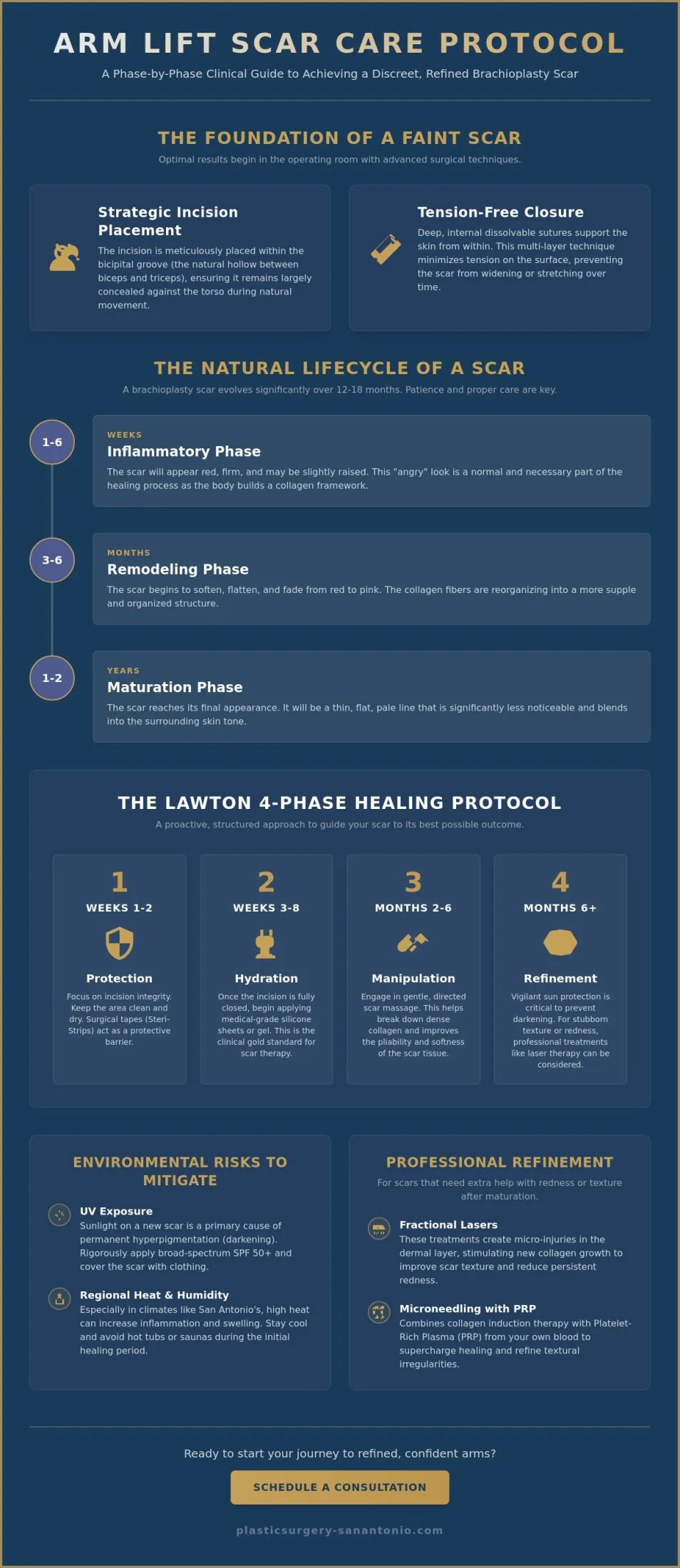
The maturation of a brachioplasty scar is a methodical process that spans up to 18 months. During weeks one through six, patients often observe an “angry” phase characterized by redness and firm texture, which is a normal indicator of active collagen production. From months three to six, the remodeling phase begins, and the tissue starts to reorganize into a more supple structure. Finally, between one and two years post-surgery, the scar enters its terminal maturation phase, typically flattening and fading into a pale line. Consistently following a professional protocol for scar care after arm lift surgery is what ensures the transition from the inflammatory stage to the final, refined outcome is as seamless as possible.
Weeks 1–6
Redness and firm texture indicate active collagen production. Normal inflammatory biological response.
Months 3–6
Tissue begins reorganizing into a more supple structure as collagen fibers realign.
Year 1–2
Scar flattens and fades into a pale, refined line at terminal stability.
The Lawton Advanced Healing Protocol: A Clinical Timeline
The recovery journey is not a passive waiting period but a proactive, four-phase clinical roadmap designed to optimize the dermal architecture. A sophisticated approach to scar care after arm lift surgery involves more than just topical creams; it requires a deep understanding of the body’s natural healing timeline. By adhering to a structured Arm Lift Recovery Protocol, you ensure that each biological stage of healing receives the specific support it requires. This methodical approach minimizes the risk of widening or hypertrophic changes, guiding the tissue toward a discreet, high-quality finish.
Weeks 1–2
Tension management with Steri-Strips and compression garments; protect newly closed skin edges.
Weeks 3–8
Transition to medical-grade silicone once wound is fully closed and “closed wound rule” met.
Months 2–6
Scar massage to break up fibrotic tissue and support collagen reorganization.
Months 6–12
Long-term protection and professional refinement if textural irregularities persist.
Phase 1 (Weeks 1-2) prioritizes incision integrity and tension management. Phase 2 (Weeks 3-8) marks the transition to medical-grade topicals once the wound is fully closed. Phase 3 (Months 2-6) involves active scar manipulation to support collagen reorganization, while Phase 4 (Months 6-12) centers on long-term protection and professional refinement if any textural irregularities persist.
Immediate Post-Operative Incision Care
In the earliest days following your procedure, surgical tapes known as Steri-Strips act as a critical biological barrier, providing external support to the newly closed skin edges. It’s vital to leave these in place until they begin to peel naturally, as they help distribute tension away from the primary incision line. Simultaneously, medical-grade compression garments play a dual role: they reduce post-operative edema and provide a stabilizing force that prevents sudden movements from straining the healing tissue. Monitoring for signs of healthy healing, such as a steady reduction in redness and swelling, is essential during this time. If you have questions about your specific progress, our team is available to provide the individualized post-operative guidance you deserve.
Transitioning to Active Scar Management
Once the incision is fully epithelized, meaning there are no open areas or scabbing, you can begin the most critical aspect of scar care after arm lift surgery: silicone therapy. This “closed wound rule” typically occurs around the third or fourth week. Silicone gel sheeting should be applied for 12 to 24 hours a day to create an occlusive environment that hydrates the scar and regulates collagen production. To further enhance results, we introduce gentle scar massage during Phase 3. This technique involves using light, circular pressure to break up fibrotic tissue, which improves the pliability of the scar and prevents it from adhering to the underlying muscle layers. This disciplined routine is what separates a standard recovery from an elite aesthetic outcome.
Essential Modalities for Scar Refinement and Fading
“Silicone remains the undisputed clinical gold standard — through the science of occlusion, it prevents transepidermal water loss and signals the body to downregulate excess collagen production.”
The journey toward a discreet result is a meticulous partnership between surgical finesse and patient discipline. While Understanding the Brachioplasty Procedure provides the anatomical context for your recovery, the modalities you employ during the first six months are what truly refine the maturing tissue. This proactive phase of scar care after arm lift surgery focuses on regulating the body’s natural healing response through occlusion and mechanical stimulation. By providing the skin with a stable environment, you ensure that collagen fibers organize in a flat, parallel fashion rather than a chaotic, raised pattern.
Beyond silicone, supporting the skin’s lipid barrier with specialized serums containing stable Vitamin E or antioxidants can enhance the remodeling process. We also emphasize the role of lymphatic drainage massage during the early months. By reducing the localized edema that often lingers in the upper arm, we alleviate the internal fluid pressure that can create a “pulling” sensation on the incision. This reduction in tension is vital for preventing the scar from widening during its most vulnerable developmental stages.
The Gold Standard: Medical-Grade Silicone
Silicone remains the undisputed clinical gold standard for scar management due to its unique ability to mimic the skin’s natural barrier. Through the science of occlusion, silicone prevents transepidermal water loss; this hydration signals the body to downregulate excess collagen production, which effectively prevents hypertrophic or keloid formation. For optimal results, a 90-day commitment is essential. Many patients prefer medical-grade sheets, such as the Oleeva® Brachioplasty Scar Treatment sheets priced around $38.32, for nighttime use because they provide continuous, high-level occlusion. During the day, silicone-based gels offer a convenient, invisible alternative that fits easily under professional or casual clothing.
Scar Massage Techniques for Tissue Pliability
Once the incision has reached sufficient tensile strength, usually around week six, we introduce the “circles and strokes” massage method. This technique involves using firm but gentle pressure to desensitize the area and break up any fibrotic, deep-tissue adhesions that might cause the scar to feel tethered or stiff. Hydration is the primary driver of success here; applying a medical-grade serum before massage makes the tissue more responsive to mechanical manipulation. We recommend a frequency of two to three times daily for five minutes per arm. This consistent stimulation promotes healthy blood flow and ensures the maturing tissue remains as soft and pliable as the surrounding skin.
Environmental Factors and the San Antonio Climate
Geography plays a significant role in the quality of your final result. For patients in San Antonio, the local climate introduces specific variables that can either support or hinder the maturation of delicate tissue. A truly sophisticated approach to scar care after arm lift surgery must account for the intense solar radiation and high thermal indices characteristic of South Texas. By understanding how these environmental stressors interact with your dermal architecture, you can proactively protect your investment and ensure a discreet, refined outcome.
Guarding Against Post-Surgical Hyperpigmentation
Sunlight is the primary adversary of a maturing incision. When fresh scar tissue is exposed to UV rays, it can trigger a process known as post-inflammatory hyperpigmentation, essentially creating a “permanent tan” along the incision line that’s incredibly difficult to reverse. This darkening occurs because the healing tissue is hyper-sensitive and lacks the normal protective mechanisms of established skin. To mitigate this risk, you should adhere to the following standards:
Apply medical-grade, broad-spectrum SPF 50+ to the treatment area every day.
Reapply outdoors even if the area is covered by light-colored summer clothing.
Commit to total sun shielding for a minimum of one full year to allow collagen to fully mature.
It’s a common misconception that a thin cotton sleeve provides sufficient protection. In reality, many summer fabrics have a low Ultraviolet Protection Factor (UPF), allowing harmful rays to reach the skin. Selecting clothing with a verified UPF 50+ rating is a clinical necessity during your first post-operative summer to maintain the integrity of the scar care after arm lift surgery.
Managing Recovery in the Texas Heat
High temperatures naturally lead to vasodilation, a process where blood vessels expand to cool the body. While this is a normal physiological response, it can cause healing incisions to throb or swell, leading to discomfort and potential tension on the scar. Staying in climate-controlled environments during the peak heat of the day is essential for those undergoing Mommy Makeover Recovery or isolated arm contouring. Excessive heat can also lead to perspiration under compression garments, which may irritate the incision site if not managed carefully.
To wear compression sleeves comfortably in the heat, choose garments made from moisture-wicking, breathable materials that prevent sweat from accumulating against the skin. Systemic hydration is also a cornerstone of dermal healing; maintaining high water intake ensures that the skin remains elastic and the metabolic processes required for tissue remodeling function at peak efficiency.
If you’re ready to begin your transformation with a team that understands these regional challenges, we invite you to schedule a private consultation to discuss your personalized recovery plan.
Professional Refinement: When Home Care Isn’t Enough
While a disciplined home-based routine is the cornerstone of recovery, certain biological healing responses may necessitate professional intervention to achieve the most discreet result possible. In some instances, the body’s inflammatory response persists longer than anticipated, or the collagen reorganization process requires clinical redirection. A truly comprehensive approach to scar care after arm lift surgery integrates advanced in-office modalities to address vascularity, texture, and volume. These treatments are not indicative of a failure in the initial protocol but rather represent the final, technical finesse required to harmonize the scar with your natural skin tone and texture.
Targets residual redness by collapsing tiny blood vessels feeding a prominent scar.
Creates microscopic treatment zones to replace fibrotic tissue with smoother, healthier skin.
Localized corticosteroids flatten hypertrophic or keloid-prone areas that feel excessively firm.
Leverages Platelet-Rich Plasma to stimulate cellular turnover in stubborn dull or irregular sections.
In rare cases where a scar has widened significantly due to excessive tension or genetic predisposition, a surgical scar revision may be considered. This procedure is typically deferred until the initial scar has fully matured, usually around the 12-month mark, to ensure the tissue has reached its terminal stability. By meticulously excising the old scar and utilizing an even more precise, tension-free closure, we can often achieve the thin, linear result that was the original goal of the brachioplasty. This commitment to long-term refinement ensures that your aesthetic journey concludes with the highest level of sophistication.
Advanced Laser and Energy Modalities
Vascular lasers are most effective when utilized early in the maturation process, often as soon as the three-month mark, to “take the red out” of an active scar. Conversely, resurfacing lasers such as Fractional CO2 are better suited for later stages when the primary goal is to blend the scar’s texture into the surrounding arm skin. Consulting with a board-certified professional is essential to timing these treatments correctly, as applying aggressive energy to an immature wound can be counterproductive. This strategic timing ensures that each modality supports, rather than disrupts, the natural biological phases of healing and scar care after arm lift surgery.
The Lawton Commitment to Aesthetic Excellence
We believe that your surgical outcome is a long-term investment that requires meticulous oversight well beyond the final stitch. Our philosophy treats the post-operative period as a holistic, high-end journey where every patient has a clear, supported path to their desired aesthetic outcome. Regular follow-up appointments are the primary anchor for this identity, allowing us to monitor your scar progression with clinical precision and intervene the moment a deviation from the ideal healing path is detected.
If you’re ready to reclaim your confidence and achieve the refined results you deserve, schedule your consultation with Dr. Lawton to discuss your arm lift journey.
Embracing Your Refined Transformation
The transition from surgical correction to aesthetic perfection is a deliberate, meticulously managed journey. By combining the clinical precision of medical-grade silicone with the proactive protective measures required by the San Antonio climate, you ensure that your results remain as discreet as they are transformative. Mastering the nuances of scar care after arm lift surgery is the final, essential step in reclaiming the freedom to wear sleeveless attire with absolute poise. This partnership between surgical artistry and disciplined recovery creates the foundation for a lifetime of confidence.
Dr. Gary Lawton, MD, FACS, brings over 25 years of surgical excellence to every procedure, ensuring that your care is as individualized as your anatomy. As a surgeon board-certified by the American Board of Plastic Surgery, he prioritizes technical finesse and facility exclusivity to provide a high-end experience grounded in safety. If you’re ready to complete your journey toward a more contoured profile, we invite you to take the next step in your personal evolution. Your path to a subtle, high-quality outcome begins with an expert plan designed specifically for you.
Frequently Asked Questions
How long do I need to wear compression sleeves after an arm lift?
Patients typically wear medical-grade compression garments for four to six weeks following their procedure to ensure optimal tissue support. This consistent pressure is vital for managing post-operative edema and providing a stabilizing force to the newly closed incision lines. By reducing the volume of localized swelling, the sleeves prevent unnecessary tension that could otherwise compromise the quality of your scar care after arm lift surgery during the critical early stages of healing.
When can I start using silicone scar sheets after my brachioplasty?
You may begin silicone therapy once the incision is fully epithelized and free of any scabbing, which generally occurs between the third and fourth week. Starting too early can trap bacteria or moisture in an unhealed wound. However, once the “closed wound rule” is met, silicone becomes the gold standard for regulating collagen synthesis and maintaining the deep hydration necessary for a flat, supple result.
Can I use Vitamin E oil on my arm lift scars?
While Vitamin E can support the skin’s lipid barrier, it should only be introduced once the incision is completely closed and the initial inflammatory phase has subsided. We recommend utilizing specialized, medical-grade serums rather than generic oils to ensure product purity and stability. Some patients experience localized dermatitis from pure Vitamin E, so it’s essential to monitor the site for any signs of irritation or redness during the remodeling phase.
Why is my arm lift scar turning dark or purple?
A dark or purple hue is a standard characteristic of the inflammatory phase, reflecting the increased blood flow required for cellular repair and tissue remodeling. This hypervascularity is a natural part of the healing process and typically transitions to a softer pink before eventually fading to a pale line. If the darkness deepens after sun exposure, it may indicate UV-induced hyperpigmentation, which reinforces the need for rigorous, year-long sun protection.
Is it normal for the scar to feel itchy or tight during recovery?
It is entirely normal for the treatment area to feel itchy or tight as the dermal layers contract and sensory nerves begin to regenerate. The itching is often a biological sign of active healing, while the tightness reflects the natural maturation of the new collagen matrix. Maintaining consistent hydration through silicone therapy and gentle massage can significantly alleviate these sensations while improving the overall pliability of the maturing tissue.
Will my arm lift scars ever completely disappear?
While no surgical incision can completely disappear, a meticulously managed scar will eventually fade into a thin, pale line that blends with your natural skin. The goal of an advanced protocol for scar care after arm lift surgery is to achieve a result so refined that it remains discreet even in sleeveless clothing. Final maturation usually takes 12 to 18 months, at which point the scar reaches its terminal, most inconspicuous state.
Can I exercise my arms while the scars are still healing?
You should avoid strenuous arm exercises or heavy lifting for at least four to six weeks to prevent mechanical strain on the healing incisions. Sudden movements or excessive weight can cause the scar to widen or stretch before it has gained sufficient tensile strength. While light walking is encouraged almost immediately to promote circulation, targeted upper-body workouts must be deferred until your surgeon confirms the tissue can handle the stress.
What should I do if my scar starts to look thick or raised?
If a scar begins to appear thick, raised, or feels excessively firm, it may be developing hypertrophic characteristics that require professional clinical intervention. In these instances, we may utilize localized steroid injections to flatten the tissue or advanced vascular lasers to reduce the underlying redness. Early detection during your scheduled follow-up appointments allows us to redirect the healing process and ensure your transformation maintains its elite aesthetic quality.
Disclaimer
Medical & Educational Disclaimer
All content presented on this website, including blog articles, written materials, images, videos, and any associated media, is provided strictly for informational and educational purposes. This content is not intended to serve as medical advice, diagnosis, or treatment, and should not be interpreted as a substitute for consultation with a qualified, licensed healthcare professional.
No doctor–patient relationship is established by your use of this website, engagement with its content, or communication through any digital platform, including contact forms, email, or social media. Medical care is highly individualized, and the information presented here may not apply to your specific condition, anatomy, or circumstances. You should always seek the guidance of a qualified physician regarding any medical concerns, treatments, or decisions.
While every effort is made to ensure accuracy and relevance, medical knowledge evolves rapidly, and no guarantee is made regarding the completeness, reliability, or current applicability of the information provided. The practice and its representatives expressly disclaim any liability for errors, omissions, or outcomes related to the use or misuse of this content.
Surgical & Aesthetic Outcomes Disclaimer
All surgical and non-surgical procedures carry inherent risks. Outcomes vary based on individual factors including anatomy, healing capacity, adherence to post-operative protocols, and overall health status. Any descriptions, discussions, or examples of outcomes presented on this website are illustrative only and should not be interpreted as guarantees of specific results. Before-and-after images, if presented, represent individual cases and do not reflect typical results.
Wellness, Nutrition & Supplementation Disclaimer
Content related to nutrition, supplementation, longevity, metabolic optimization, and integrative or holistic health strategies is provided for educational purposes only. These discussions may include emerging science, theoretical frameworks, or practitioner-based protocols that are not universally accepted within conventional medical standards. Supplements and wellness interventions may interact with medications or underlying health conditions. Consultation with a qualified healthcare provider is strongly recommended prior to initiating any new regimen.
Affiliate & Financial Disclosure
This website may contain links to third-party products, services, or platforms. Some of these links may be affiliate links, meaning a commission may be earned if a purchase is made through them. This comes at no additional cost to you. Product recommendations are based on professional judgment, clinical experience, and research; however, no guarantees are made regarding performance, efficacy, or outcomes. The practice assumes no responsibility for third-party products, services, or claims.
External Links Disclaimer
This website may reference or link to external websites for informational purposes. These sites are not controlled or operated by this practice, and no responsibility is assumed for the accuracy, content, privacy practices, or policies of any third-party website.
Limitation of Liability
By using this website, you acknowledge and agree that you assume full responsibility for any actions taken based on the information provided. Under no circumstances shall the practice, its physicians, affiliates, or representatives be liable for any direct, indirect, incidental, or consequential damages arising from the use of this content.
Consent
By accessing and using this website, you acknowledge that you have read, understood, and agree to this disclaimer in its entirety.